
What Is Nickel-Free Eyewear? Materials, Testing, and Compliance
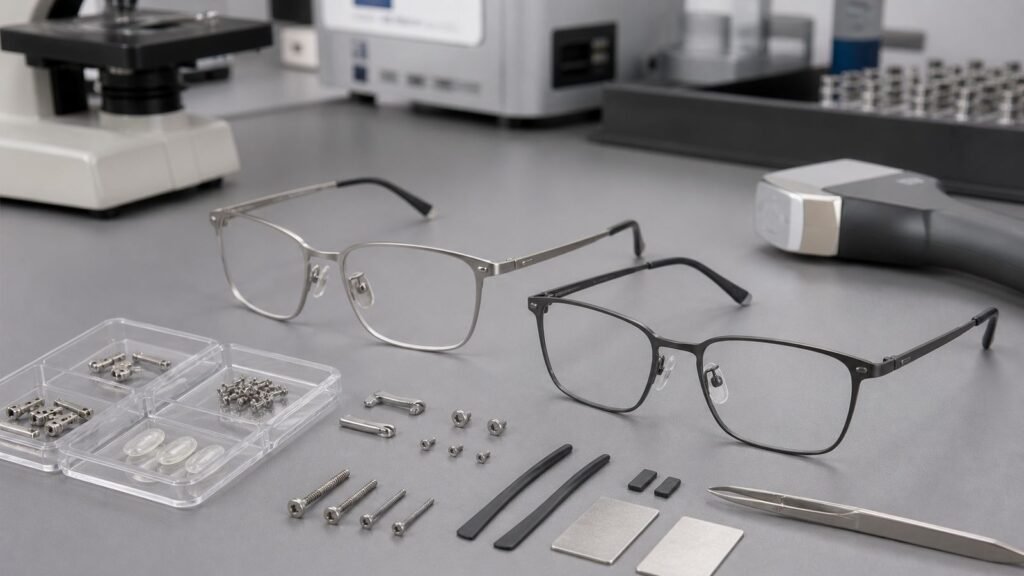
Nickel-free eyewear sounds like a simple material claim. It is not. The phrase can mean no intentionally added nickel, no nickel detected by a screening method, or a finished frame that stays below an applicable nickel-release limit. Those claims answer different questions. A titanium front can also pass while a screw, hinge, solder joint, or plated temple fails. Buyers need a component map, a named test method, and a report tied to the production model. This guide explains how to turn "nickel-free" from a label into a verifiable eyewear specification.
What does nickel-free eyewear mean?
There is no single worldwide definition of nickel-free eyewear. The useful meaning depends on the claim, market, product construction, and test method.
Three interpretations appear often:
- No intentionally added nickel. The supplier says nickel is not part of the specified alloy, plating, solder, or coating recipe. Trace content or contamination may still exist.
- No nickel detected. A screening instrument or chemical spot test did not detect nickel under its stated conditions. The result depends on the method and detection limit.
- Nickel release complies with a limit. A finished frame was tested for nickel ions released from skin-contact parts and met the applicable criterion.
The third interpretation is the one used in the European REACH restriction for articles in direct and prolonged skin contact. REACH controls release, not a blanket zero-nickel composition. A compliant article may contain nickel in its bulk alloy if it releases nickel below the legal limit under the required test route.
That distinction is not wordplay. It changes how you select materials, approve coatings, write purchase orders, and review laboratory reports.
Why nickel release matters in eyewear
Nickel is a skin sensitizer. The European Chemicals Agency says nickel has long been a main cause of skin allergies in Europe. Sensitization may develop without a visible reaction during the first contact. Later exposure can trigger allergic contact dermatitis.
The ECHA overview of skin-sensitizing chemicals explains that re-exposure can produce an allergic response after sensitization. A compliant frame lowers the controlled release risk covered by the regulation. It does not diagnose an allergy or guarantee that every wearer will tolerate every material in the frame.
Eyewear creates a relevant contact pattern. Nose-pad hardware, bridges, lower rims, temple surfaces, temple tips, and other metal parts can touch skin for many hours. Sweat, cosmetics, cleaning products, abrasion, and repeated adjustment can change the surface over time.
Nickel content and nickel release are different
Nickel content tells you how much nickel is present in a material. Nickel release tells you how much nickel leaves the surface under a defined test and exposure.
A bulk alloy can contain nickel yet release little because its surface is stable. A plated part may have modest nickel content overall but release more from a thin nickel-rich underlayer after the top finish wears. Geometry, polishing, porosity, corrosion, and coating damage all affect the result.
This is why an XRF result cannot replace a release test. X-ray fluorescence is useful for screening alloy and plating composition. It does not reproduce sweat exposure or measure the release rate from the skin-contact surface.
The same caution applies to a dimethylglyoxime spot test, often called a DMG test. CEN/TR 12471:2022 describes DMG as a qualitative screening method for the presence of nickel. It identifies EN 16128 as the reference method for spectacle frames and sunglasses.
Use screening to find risks and verify incoming materials. Use the product-specific release method for the compliance decision.
Which eyeglass frame parts can contain nickel?
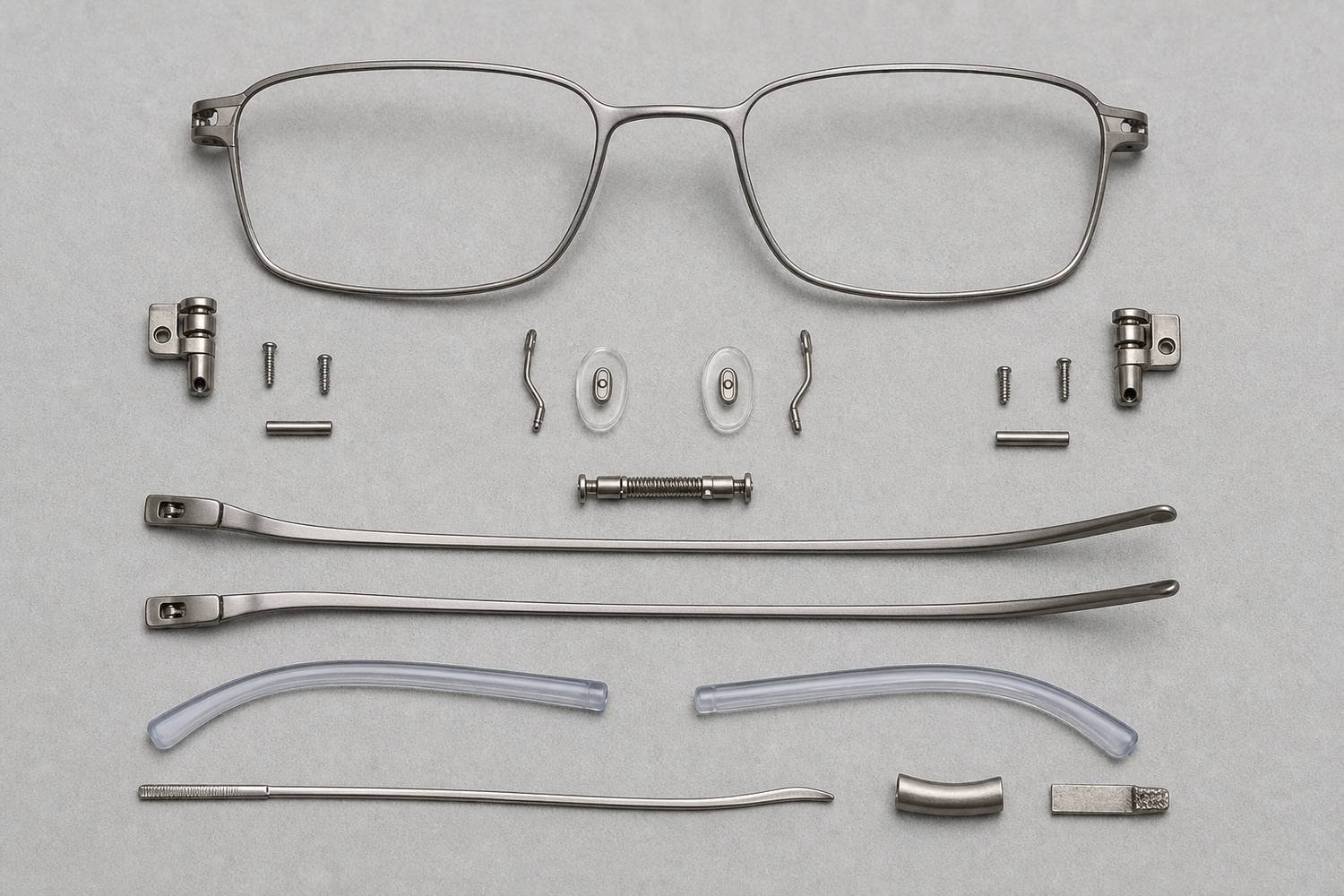
An eyewear material claim must cover the whole assembled model rather than the front material printed on a catalog page.
Fronts, rims, and bridges
Metal fronts may use titanium, stainless steel, nickel silver, copper alloys, aluminum alloys, or mixed constructions. A front described as titanium can still include a different bridge insert, rim lock, trim, or brazed detail.
Ask for the exact grade and component boundary. Our guides to titanium eyewear and titanium alloy eyewear explain why a family name is not a complete material specification.
Temples and temple cores
A visible plastic temple can hide a metal core. A titanium temple can use a steel spring, insert, or end piece. Temple tips may reduce contact with the metal underneath, but gaps, worn tips, or exposed adjustment zones can change the real contact area.
Hinges, screws, and spring mechanisms
Small hardware is easy to miss in a material declaration. Hinge barrels, screws, washers, pins, and spring-hinge cartridges may come from separate suppliers and use different alloys or finishes.
Small size does not automatically remove the risk. The laboratory must decide which parts fall within the applicable method and how to prepare them.
Nose pads and pad arms
The soft pad may be silicone or another polymer, while the pad box, screw, insert, and pad arm are metal. Sweat can collect around these parts. Treat the nose-pad assembly as several components during bill-of-material review.
Solder, brazing filler, and welded joints
Joining materials may differ from the parent metal. A nominally nickel-free tube does not prove that its brazed joint or filler is nickel-free. Welding can also mix adjacent materials at the joint.
Require the joining process and consumable designation. Do not accept "same as frame" unless the supplier can trace it.
Plating and coating layers
A decorative surface may include cleaning treatments, strike layers, metal underlayers, color plating, PVD, lacquer, or an organic topcoat. Nickel can sit below a finish that looks nickel-free.
Our guide to PVD coating on titanium eyeglass frames explains why a coating name does not reveal every layer. The complete coating stack belongs in the controlled specification.
Which eyewear materials are commonly considered nickel-free?
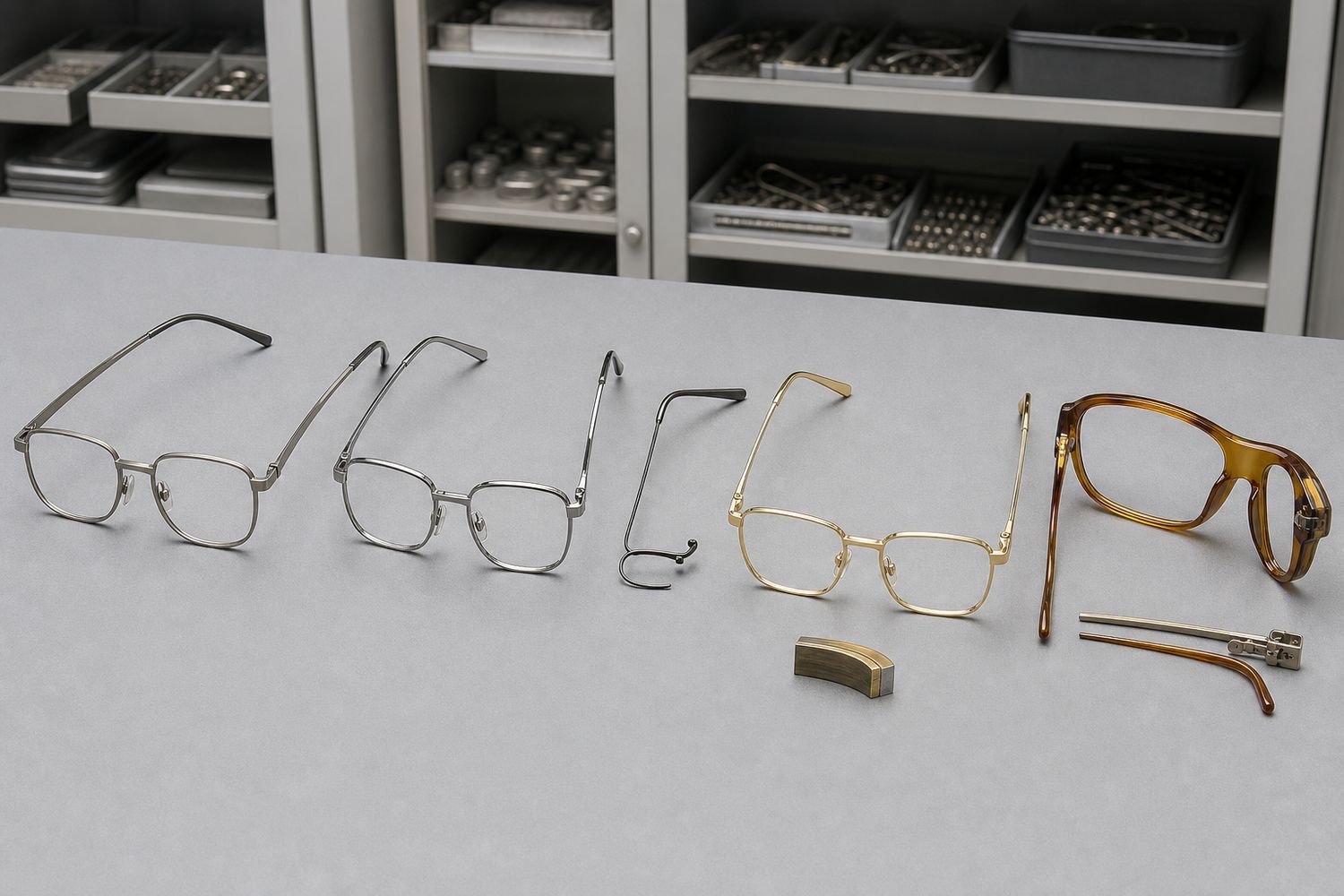
Material selection can reduce risk, but no family name replaces supplier documentation and finished-product testing.
| Material or construction | Nickel concern | Buyer check |
|---|---|---|
| Commercially pure titanium | Usually selected without intentional nickel alloying | Confirm grade, certificate, attached parts, and surface process |
| Beta titanium | Composition varies by grade and supplier | Obtain the exact alloy designation and chemistry |
| Nickel-titanium memory alloy | Nickel is a major alloy component | Do not claim nickel-free by composition; evaluate release and market wording |
| Stainless steel | Many grades contain nickel | Confirm grade and test relevant skin-contact parts |
| Nickel silver or German silver | The alloy name commonly covers copper-nickel-zinc materials | Do not mistake "silver" for nickel-free |
| Acetate or injected polymer frame | Main body may contain no metal | Check cores, hinges, screws, trims, and pad hardware |
| Coated metal | Base alloy or underlayers may contain nickel | Qualify the complete finish after wear and corrosion treatment |
Commercially pure titanium
Commercially pure titanium is often a practical starting point for a low-nickel material strategy. The front, temple, hinge, screws, and joining materials still need separate identification. See our pure titanium eyewear buyer checks for grade and traceability questions.
Beta titanium
Beta titanium is a broad material category, not one recipe. Many eyewear grades use alloying elements selected for spring behavior and formability. Buyers should not infer nickel content from the beta label. Request the exact grade and chemical certificate. Our beta titanium guide covers that distinction.
Memory titanium and nickel-titanium
Some memory titanium products use nickel-titanium, also called NiTi or Nitinol. Such a part cannot honestly be called nickel-free by composition. It may still meet a nickel-release requirement when the surface and finished product pass the correct method.
The phrase "memory titanium" is not proof either way. Our memory titanium guide explains why the exact alloy and recovery mechanism must be disclosed.
Stainless steel and copper alloys
Many stainless-steel and copper-alloy frame materials contain nickel. Different grades, surface conditions, and coatings can produce different release results. A generic declaration for "steel" or "metal" provides little control.
Plastic and combination frames
Acetate, polyamide, and other polymer fronts can reduce the area of exposed metal. They do not remove every metal part. Inspect hidden cores, hinges, screws, rivets, trims, clips, and nose-pad hardware.
What does EU REACH require for nickel release?
Entry 27 of Annex XVII to REACH restricts nickel and its compounds in articles intended for direct and prolonged contact with skin. The limit for the relevant contact parts is 0.5 micrograms per square centimeter per week.
The legal text also addresses articles with a non-nickel coating. The coating must keep release at or below 0.5 micrograms per square centimeter per week for at least two years of normal use. The current wording is available in the consolidated REACH regulation on EUR-Lex.
The separate 0.2 microgram limit applies to post assemblies inserted into pierced body parts. It is not the spectacle-frame limit. Copying the earring requirement into an eyewear report creates confusion rather than extra safety.
REACH controls placing covered articles on the EU market. It applies to imports as well as domestic production. The company placing the frame on the market remains responsible for its compliance file even when a supplier arranges the test.
Rules outside the EU vary. Great Britain operates UK REACH separately, while EU REACH continues to apply in Northern Ireland. The UK Health and Safety Executive tells businesses to check both systems where necessary. For any other destination, have the importer identify the applicable law, standard edition, labeling rules, and document retention period before production.
Which nickel-release standard applies to eyewear?
EN 16128 is the eyewear-specific reference method
BS EN 16128:2025 covers spectacle frames, ready-to-wear near-vision spectacles, sunglasses, and relevant eye-protection frames. It applies to metal parts intended for direct and prolonged skin contact and supports the 0.5 microgram limit.
The standard includes a route for electrically non-conductive coatings and a quantitative migration route. It also addresses selection and preparation of frame parts. That product-specific treatment matters because an eyeglass frame is more awkward than a flat metal coupon.
EN 1811 is not the spectacle-frame method
BS EN 1811:2023 covers other skin-contact articles and piercing posts. Its scope excludes spectacle frames and sunglasses and points those products to EN 16128.
If a supplier gives you an EN 1811 report for a complete eyewear model, ask the laboratory to explain why it used that method instead of EN 16128. A standard number is not decoration. Its scope has to fit the product.
Write the edition into the test request
Document control needs attention in 2026. BSI lists EN 16128:2025 as current and records the 2015 edition as withdrawn. The European Commission's 2023 list of standards under REACH entry 27 still cites EN 16128:2015.
That timing creates a practical question for importers and laboratories. State the requested edition, target market, and legal basis in the test order. Ask the accredited laboratory and responsible importer to confirm which edition they will use for the conformity file. Do not silently mix preparation from one edition with pass criteria from another.
How EN 16128:2025 tests a spectacle frame
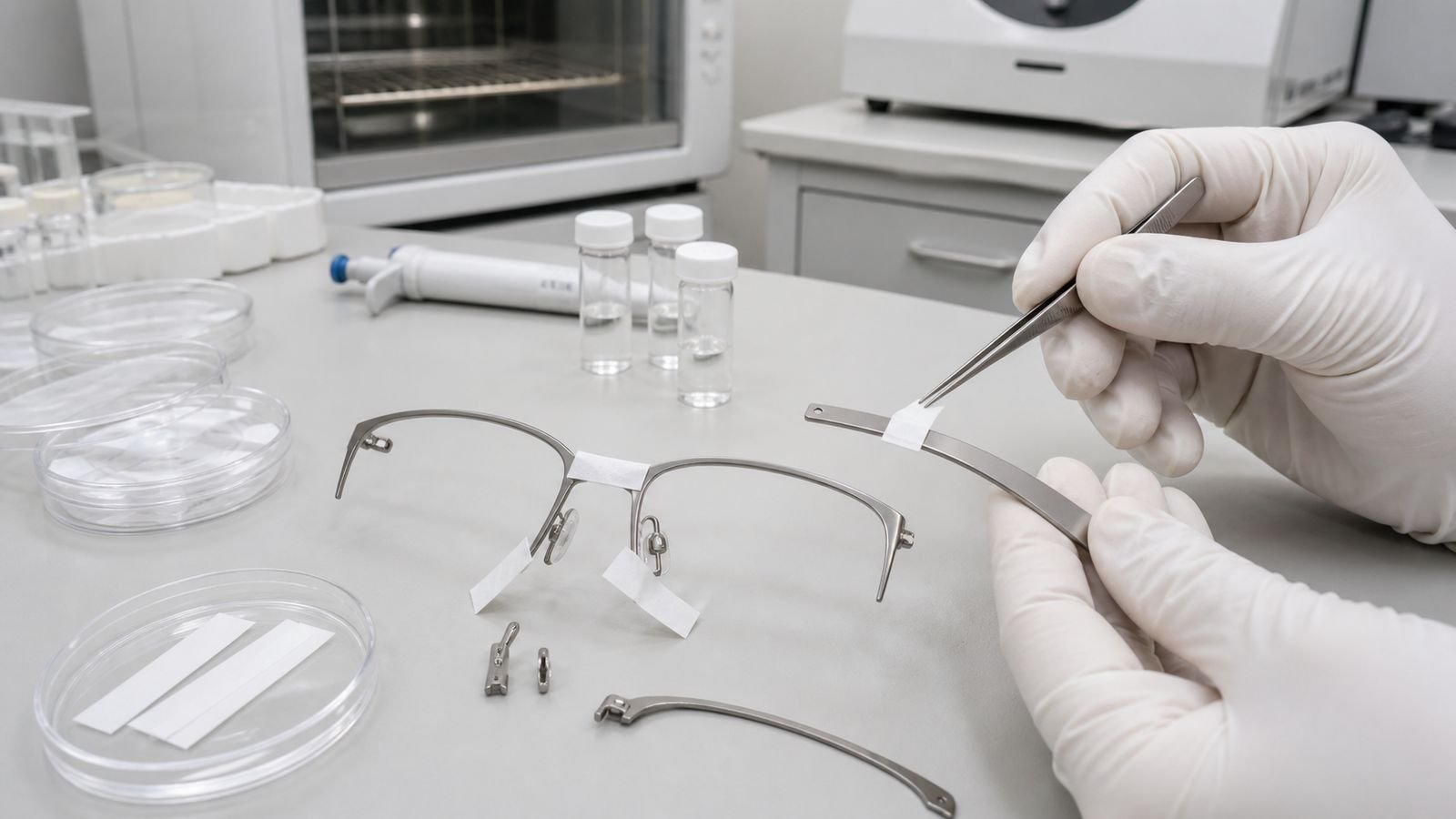
The current method uses a decision path based on the frame construction and surface.
1. Select relevant models and parts
The test plan identifies metal parts intended for direct and prolonged skin contact. It records the model, size, color, finish, construction, and samples. Combination frames may need disassembly, cutting, masking, or separate treatment of small components.
Testing one easy-to-handle temple coupon is not the same as testing the frame model. Coupons help process control, but the compliance sample must represent the production product and the standard's selection rules.
2. Simulate wear and corrosion when required
Coated and plated parts may need accelerated wear and corrosion treatment before the final decision. This step challenges the barrier that is expected to limit release during use.
The test is not a promise that every wearer will create exactly the same wear pattern. It is a standardized comparison that makes supplier and laboratory results more consistent.
3. Evaluate a suitable non-conductive coating
EN 16128:2025 includes an electrochemical coating test based on impedance for suitable electrically non-conductive coatings. A passing result can support conformity for the tested model.
This route does not fit every component. Very small parts, uncoated metals, conductive finishes, magnets, or unsuitable geometry may need the migration route. The laboratory should document its decision.
4. Measure nickel migration
The migration test uses artificial sweat to release nickel ions from the test surface into prepared test paper. The laboratory then measures the nickel collected in that paper and calculates the release result against the applicable limit.
This measures what leaves the contact surface under the method. It is different from measuring total nickel in the part.
5. Report each decision and result
The report should identify tested parts, preparation, surface area, method edition, route, equipment, results, units, decision rule, deviations, and sample photographs. A one-line certificate that says "nickel free: pass" is too thin for a production compliance file.
How buyers should specify nickel-free eyewear
Define the claim before sampling
Choose the wording you need:
- no intentionally added nickel in named materials and processes;
- nickel content below a stated detection or specification limit;
- compliant nickel release from finished skin-contact parts;
- or a combination of these controls.
Do not let the supplier choose the definition after the test result arrives.
Build a component and contact map
List the front, bridge, rims, temples, cores, tips, hinges, screws, pad arms, pad boxes, trims, clips, magnets, solders, fillers, plating layers, and coatings. Mark material, supplier, finish, and expected skin contact for each item.
This map also helps an OEM eyewear manufacturing team choose test samples and control later substitutions.
Control the full finish stack
Record base alloy, pretreatment, underlayers, decorative layer, topcoat, cure, thickness range, and approved processor. If a nickel-containing underlayer is prohibited, say so directly. If it is allowed only when the finished frame passes release testing, write that instead.
Test representative production samples
Use finished samples from the production process, not polished raw-material swatches. Cover the frame sizes, colors, and constructions that could change contact area or surface behavior.
The highest-risk sample is not always the darkest color or largest eye size. Ask the process owner which finish stack, geometry, or coating load is hardest to control, then document the family rationale.
Set change-control triggers
Require review or retesting after changes to:
- base material grade or material supplier;
- screw, hinge, spring, core, or pad hardware;
- solder, brazing filler, or welding consumable;
- plating underlayer, coating chemistry, thickness, or processor;
- frame geometry that changes skin contact;
- test standard edition or destination-market requirement.
A test report belongs to a defined construction. It does not grant permanent immunity to substitutions.
What should be in a nickel-release test report?

Use this checklist before accepting a report:
Product identity
- brand or customer reference;
- model and size;
- color and finish code;
- production or sample lot;
- clear photographs of the tested frame.
Method identity
- EN 16128 edition;
- target regulation and limit;
- sample selection and preparation;
- wear and corrosion treatment, when applicable;
- coating or migration test route;
- any deviation from the method.
Results
- tested component or area;
- measured surface area;
- numerical result and unit for migration tests;
- pass or fail decision and decision rule;
- blank, detection limit, or measurement uncertainty information where reported by the method and laboratory.
Laboratory information
- laboratory name and report number;
- issue date and authorized signatory;
- accreditation scope relevant to the method;
- page numbering and report integrity controls.
Do not accept a cropped result table without the sample description and method page. That is a screenshot, not a compliance file.
Common nickel-free eyewear claim failures
Testing only the titanium front
The front passes, but the steel screw, pad arm, or temple insert was never tested. The marketing claim covers the frame while the report covers one part.
Using composition as the only proof
An XRF scan identifies a nickel-containing layer or alloy. It does not calculate release per square centimeter per week. The reverse is also true: a release pass does not prove zero nickel content.
Relying on a fresh coating
A new lacquer or plating can hide a nickel-rich substrate. REACH specifically addresses continued release control from coated items over normal use. The applicable wear and corrosion preparation cannot be skipped because the sample looks perfect.
Reusing one report across different finishes
Black, gold, silver, painted, and plated versions may use different layer stacks or processors. Treat a finish family as one group only when the manufacturer and laboratory can defend the grouping.
Ignoring component substitutions
Factories may replace screws, hinges, or pad hardware when the original source is late. A visually identical part can use another alloy or plating. Approved supplier lists and incoming checks need to cover these small components.
Calling a release pass allergy-proof
Regulatory compliance and individual medical tolerance are not the same. A wearer can react to other metals, coatings, polymers, cleaners, or trapped moisture. Anyone with symptoms should stop using the product and seek qualified medical advice.
Frequently asked questions
Is titanium eyewear always nickel-free?
No. The main titanium part may use no intentional nickel, but attached hardware, memory-alloy sections, solder, plating, or underlayers can contain it. Verify the bill of materials and test the finished frame where required.
Can a nickel-containing alloy pass a nickel-release test?
Yes. REACH controls the nickel released from relevant contact parts, not total nickel content. A stable alloy or qualified surface may stay below the release limit. That does not make the alloy nickel-free by composition.
Is stainless steel safe for nickel-sensitive wearers?
Stainless-steel grades and surfaces vary, and many contain nickel. A grade name alone does not predict individual tolerance or product compliance. Review material documentation and the applicable release result.
Is XRF testing enough for nickel-free eyewear?
No. XRF is useful for material and coating screening, but it does not measure nickel migration in artificial sweat. Use it alongside, not instead of, the required release method.
Does PVD make a frame nickel-free?
Not automatically. PVD may create a barrier, but performance depends on the complete coating stack, coverage, adhesion, wear, and substrate. Test the finished surface under the correct product method.
How often should nickel-release testing be repeated?
No single interval fits every program. Retest when the construction, material, supplier, finish, processor, contact geometry, standard edition, or market requirement changes. A buyer may also set periodic verification based on volume and risk.
Does EN 1811 apply to spectacle frames?
The current EN 1811 scope excludes spectacle frames and sunglasses and points them to EN 16128. Put the eyewear-specific method and edition in the test request.
Turn the claim into controlled evidence
Nickel-free eyewear needs more than a supplier declaration. Define whether the claim concerns composition, detection, or release. Map every metal component and finish layer. Then use the product-specific test method and keep the report tied to the approved production construction.
Developing a titanium frame for a regulated market? Review our titanium eyeglass frame capabilities or contact us with the component list, target markets, finish variants, quantities, and required test standard for a structured manufacturing review.