
What Is Memory Titanium? Benefits, Limits, and Common Myths
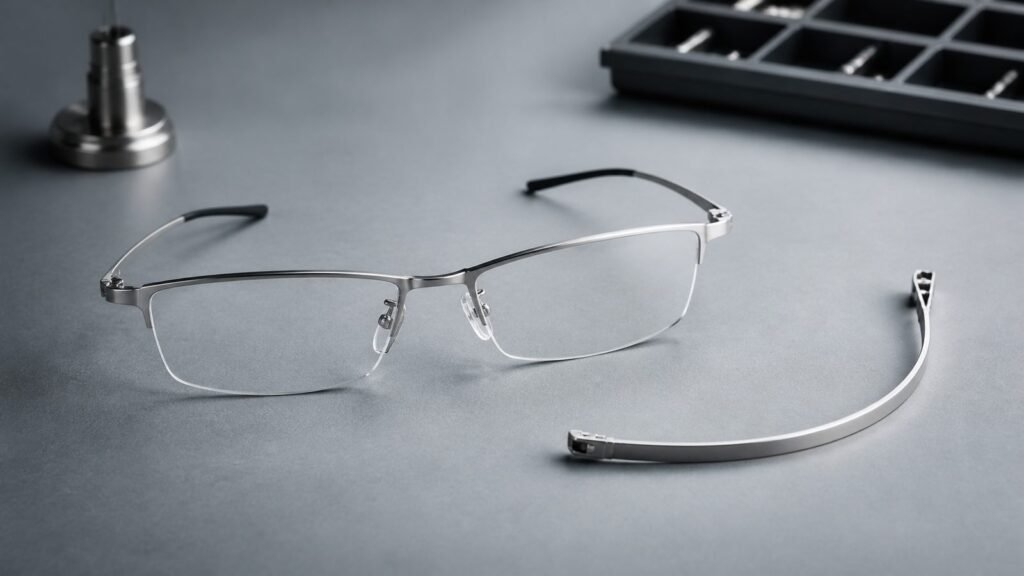
Memory titanium is an eyewear trade label usually applied to titanium-based parts that recover after large bends. The label may refer to a nickel-titanium shape-memory alloy, a superelastic alloy, or simply a springy titanium component. Those are not the same thing. Temperature, alloy chemistry, processing, and part geometry determine the recoverable bend. This guide separates the useful engineering from the bend-it-for-the-camera mythology.
What does "memory titanium" mean in eyewear?
There is no single universal eyewear grade called "memory titanium." A supplier may use the phrase for nickel-titanium, often called NiTi or Nitinol. Another may use it for a proprietary titanium alloy with high elastic recovery. A third may use it as a sales label for a thin beta titanium temple.
The difference matters because the recovery mechanism changes what you should test. An ordinary spring material returns while stress stays below its elastic limit. A shape-memory alloy can use a solid-state phase transformation to recover much larger deformation under defined conditions.
The NASA Glenn overview of shape-memory alloys describes how these materials change crystal structure with temperature and stress. In nickel-titanium systems, the relevant phases are commonly called austenite and martensite.
If a specification says only "memory titanium," ask for the exact alloy, material condition, transformation temperatures, and claimed recovery behavior. The marketing name is the start of the question, not the answer.
For context, see our guides to what titanium eyewear is and what beta titanium is.
Shape memory and superelasticity are different
Both effects can come from a phase transformation, but they operate in different ways.
Shape-memory effect
In a classic one-way shape-memory cycle, the alloy is deformed in its lower-temperature martensitic state. Heating it above a transformation range returns the material toward its trained shape. Cooling it again does not automatically recreate the deformed shape.
This behavior is useful in actuators and thermal devices. It is less convenient for everyday eyewear if recovery requires a carefully controlled heat step. A consumer should not need a metallurgy lab to straighten a temple.
Superelasticity
Superelasticity, also called pseudoelasticity, occurs when stress triggers a reversible phase transformation at the service temperature. The part can take a large apparent strain and recover when the load is removed, without a separate heating step.
For flexible eyewear, this is often the behavior people expect when they hear "memory frame." The exact response depends on the alloy's transformation temperatures relative to the temperature of use. A frame tested in a warm room may behave differently after sitting in a cold car.
The physical metallurgy is well documented in the review Physical metallurgy of Ti-Ni-based shape memory alloys. An eyewear buyer does not need to model every phase boundary, but the supplier should know which effect supports the product claim.
Ordinary elastic springback
Ordinary elastic recovery does not require a phase transformation. Commercially pure titanium, beta titanium, and steel can all spring back within their elastic range. Once a part passes that range, permanent deformation remains.
Some products called memory titanium rely mostly on this conventional spring behavior. That may still produce a good frame. It simply needs an honest name and a measurable recovery requirement.
What are the benefits of memory titanium eyewear?
Large recoverable bends
A correctly processed superelastic part can recover from more strain than an ordinary metal spring of similar form. This helps temples tolerate spreading, twisting, and accidental handling.
Recovery is not infinite. Tight kinks, sharp tool marks, crushed sections, and repeated overload can still leave damage. A bridge under a chair leg is not a valid laboratory protocol, despite what social media may suggest.
Comfort through controlled flex
Flexible temples can reduce pressure variation across different head widths. The frame can adapt during wear while maintaining contact at the intended points.
Too little stiffness causes its own problem. Temples still need enough holding force to keep the optical centers stable and prevent the frame from sliding. Comfort comes from controlled force, not maximum bendiness.
Durability under repeated movement
Superelastic alloys can perform well in parts that see repeated flex when the strain stays within the design range. Eyewear makers may use them in temples, bridges, or flexible connecting elements.
Fatigue life depends on surface condition, strain amplitude, inclusions, heat treatment, and local geometry. A smooth, gradual curve is kinder to the material than a sharp notch near a weld.
Thin and light-looking components
High recoverable strain can support slim components. That can help a designer make a light frame, but the alloy itself is not necessarily lighter by volume than commercially pure titanium. Nickel-titanium is denser because of its nickel content.
Judge the assembled frame weight in the approved eye size. A material nickname cannot sit on a scale.
Where do the limits appear?
Hinges and joints do not inherit memory
A frame may use a memory-alloy temple with a conventional hinge, screw, weld, or end piece. Those joints can loosen or deform even when the long temple section recovers. Product testing must include the complete load path.
Permanent deformation is still possible
Excessive strain can leave a permanent set. A localized fold is more damaging than a broad bend because it concentrates stress. If a user creates a sharp kink, the part may not return to its original line.
Temperature changes the response
Transformation temperatures control whether a shape-memory alloy acts martensitic, superelastic, or somewhere between. Storage, shipping, winter use, and hot-car exposure can change feel and recovery.
A buyer should define a service-temperature range and test the frame at relevant points within it. Room-temperature proof alone may miss a cold-weather problem.
Adjustment and repair can be difficult
A conventional metal temple can often be bent into a new fitted position. A superelastic temple may resist that adjustment and return toward its trained shape. Local heating can alter properties, coatings, or joints.
The fitting guide should tell opticians which areas are adjustable and which are not. Repair instructions should identify prohibited heat and tooling.
Surface damage still matters
Scratches, grinding marks, sharp holes, and damaged edges can start fatigue cracks. Flexible parts move more, so their surface quality deserves close attention. Finishing should remove burrs without cutting a thin section below its minimum thickness.
Where is memory titanium used in frames?
Temples
Long temples provide room for smooth, distributed bending. Memory-alloy wire or strip can be used through much of the temple, then joined to conventional tips and hinge parts.
Bridges
A flexible bridge can tolerate spreading or twisting, but it must still control lens position and face-form angle. The connection between bridge and rims deserves its own strength and fatigue checks.
Rimless and semi-rimless structures
Thin flexible components can suit light constructions. Loads around drilled lens holes, bushings, screws, and nylon cords must remain controlled. The lens is less impressed by a material demo than the sales team is.
Hybrid assemblies
Many designs combine a memory-alloy component with pure titanium, beta titanium, stainless steel, acetate, or polymer parts. A component-level bill of materials should state each material and joining method.
How are memory titanium parts manufactured?
Alloy and stock preparation
The process begins with a controlled alloy and stock form. Wire, strip, tube, and sheet can respond differently because their prior cold work and heat history differ. Material certificates need a traceable heat or lot number.
Shape setting
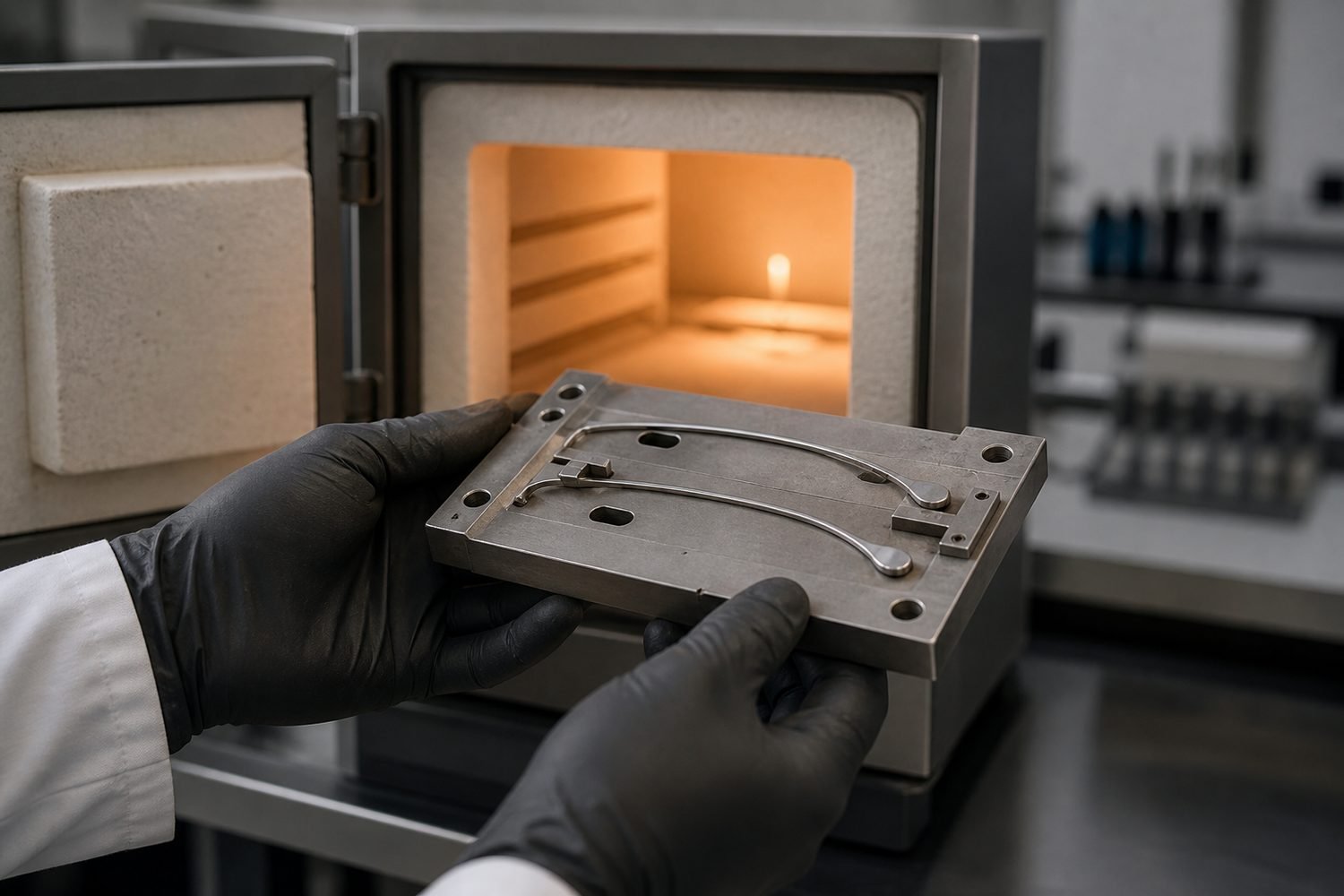
Shape-memory parts are commonly constrained in a fixture and heat treated to set the intended geometry. Time, temperature, atmosphere, fixture contact, and cooling affect the result. The supplier should validate these parameters for the chosen alloy and section.
Cutting, forming, and edge control
Laser cutting, stamping, machining, and forming can introduce heat-affected zones or surface defects. Parts should have smooth transitions and clean edges. Burrs are small, but fatigue cracks appreciate the invitation.
Joining
Joining NiTi or other memory alloys to themselves or to conventional metals can be difficult. Welding heat changes local microstructure, while brazing or mechanical joining adds different materials to the assembly. The joint may become the least flexible part of the frame.
Production validation should include joint strength and cyclic loading. Our eyewear manufacturing overview explains how component forming and joining fit into the full process.
Finishing
Polishing, blasting, coating, and plating can change surface condition. A coating must tolerate repeated flex without cracking or peeling. If the base alloy contains nickel, surface finishing alone should not be treated as permanent proof of low nickel release.
What should buyers specify and test?
1. Exact material identity
Request the alloy designation, applicable specification, stock form, and delivery condition. State which frame components use it. Do not accept "memory metal" as the only material field on a bill of materials.
2. Intended recovery mechanism
Ask whether the claim relies on superelasticity, heat-triggered shape memory, or ordinary elastic springback. Record the transformation temperatures when a phase transformation is involved.
3. Service-temperature range
Define the temperatures at which the frame must fit, flex, and recover. Include cold and warm conditions that reflect shipping, storage, and normal use.
4. Bend and recovery method
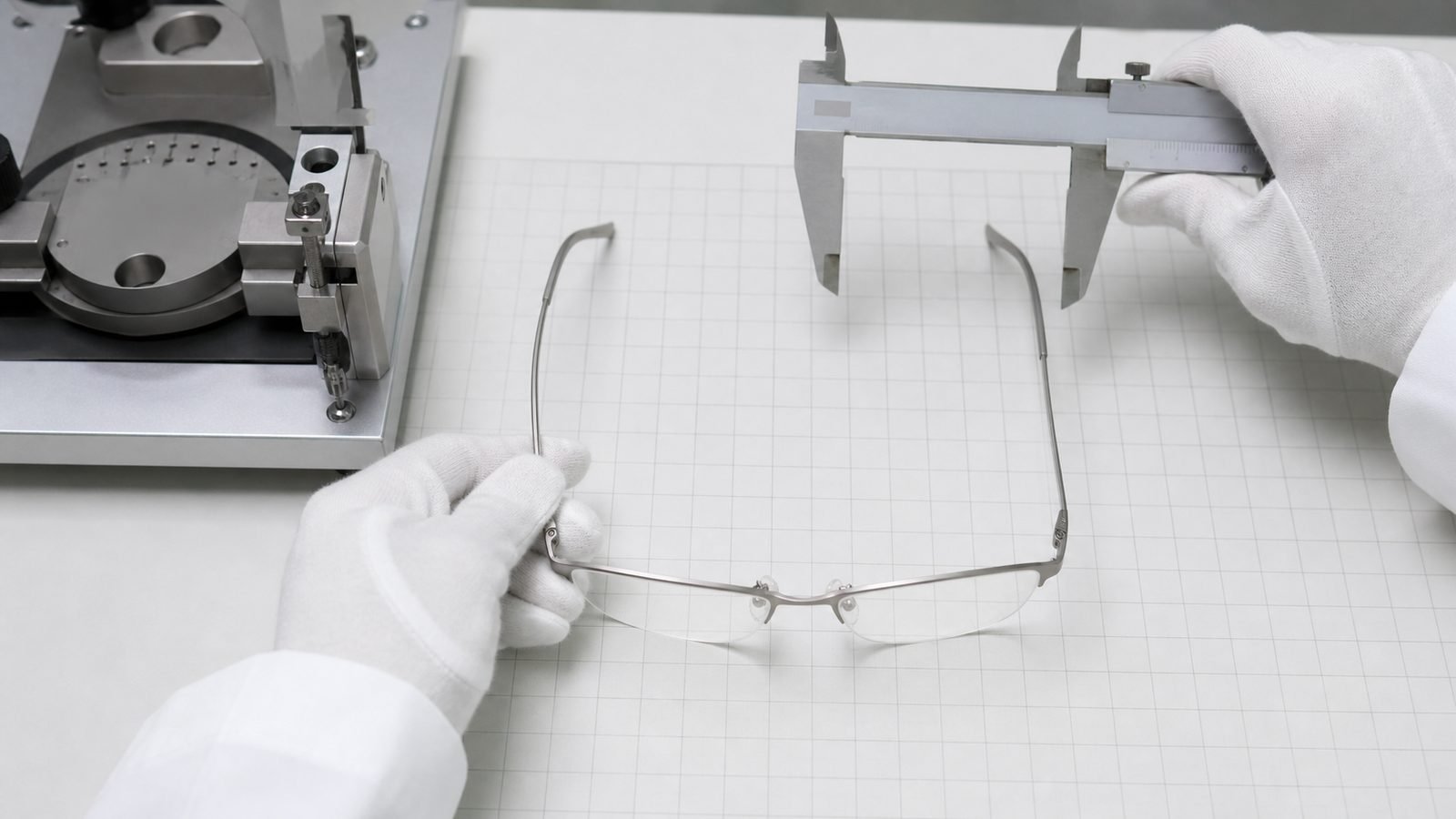
Specify the loading point, bend angle or displacement, hold time, release method, and allowed permanent offset. State whether the test applies to a material coupon, a component, or the complete frame. The complete frame gives the most useful product answer.
5. Cycle and fatigue checks
Set the number of flex cycles and the inspection interval. Measure alignment, temple spread, hinge function, coating condition, and visible cracking after the test. Record failures by location so the design team can fix the actual weak point.
6. Finished-frame testing
ISO 12870 provides requirements and test methods for spectacle frames. The full plan should also reflect the destination market and product claims. Our quality control overview shows how material evidence and finished-frame tests work together.
7. Nickel-release evidence
Many products sold as memory titanium use a nickel-titanium alloy. Nickel is part of that base material, not an accidental trace. A suitable surface and stable oxide may control release, but composition alone cannot prove compliance.
For markets covered by nickel-release rules, test the complete product using the applicable method. The EU REACH nickel restriction applies to relevant articles intended for direct and prolonged skin contact.
Common memory titanium myths
| Claim | Better technical answer |
|---|---|
| "It can never bend permanently" | Every design has a recoverable range; overload and kinks can leave damage |
| "Memory titanium always means nickel-titanium" | The trade label is ambiguous; request the exact alloy |
| "It returns to shape at any temperature" | Shape-memory and superelastic response depend on transformation temperatures |
| "The whole frame has memory" | Only specified components may use the memory alloy |
| "Flexible means unbreakable" | Joints, surface defects, coatings, and fatigue can still fail |
| "Titanium means nickel-free" | NiTi contains nickel, and other frame components may contain it too |
Frequently asked questions
Is memory titanium the same as Nitinol?
Not always. Nitinol is a nickel-titanium shape-memory alloy, while "memory titanium" is a broader trade label. Verify the alloy rather than inferring it from the product name.
Can memory titanium glasses be adjusted?
Some areas can be adjusted, but a superelastic section may resist permanent setting. The manufacturer should provide an adjustment map and limits for heat and tools.
Do memory titanium frames return to shape in cold weather?
That depends on the alloy's transformation temperatures. A frame can feel softer, stiffer, or less recoverable outside its intended temperature range. Test the approved product under relevant conditions.
Are memory titanium frames nickel-free?
Do not assume so. Nickel-titanium contains nickel, and mixed components may add other nickel sources. A nickel-release claim needs finished-product evidence for the target market.
Is beta titanium a memory metal?
Ordinary beta titanium eyewear usually relies on elastic springback, not a shape-memory transformation. A specific metastable alloy may show unusual recovery, but the supplier must identify and test that behavior.
Replace the twist demo with a test method
Memory titanium can solve real fit and durability problems when the alloy, temperature range, and frame design agree. Define the recovery mechanism, test the assembled frame, and inspect the joints after cycling. That produces useful evidence long after the dramatic bending video ends.
Developing a flexible titanium frame? Review our titanium eyeglass frame capabilities or contact us with your material claim, target temperature range, drawings, and recovery test.