
What Is Titanium Eyewear? Materials and Manufacturing Guide
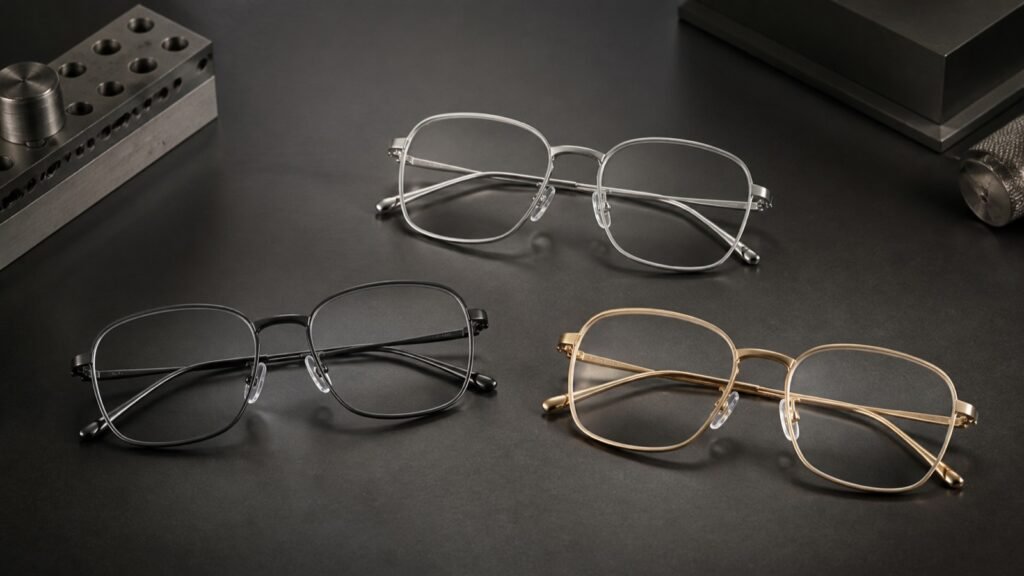
Titanium eyewear is a family of eyeglass frames made partly or primarily from titanium-based materials. Buyers often choose it for low weight, corrosion resistance, and the ability to create thin profiles without making a frame feel flimsy. But the word titanium on a line sheet does not tell you which alloy was used, which parts contain it, or how the frame was processed. Those details decide how the finished product fits, flexes, ages, and passes inspection. This guide explains the material options, manufacturing steps, and questions you should settle before approving production.
What Is Titanium Eyewear?
Titanium eyewear is an optical or sunglass frame that uses commercially pure titanium, a titanium alloy, or a titanium-based flexible material in one or more structural parts. Those parts may include the rims, bridge, temples, end pieces, or nose-pad arms.
That definition leaves room for mixed construction. A frame may have titanium fronts and different hinge screws, nose-pad hardware, solder, or decorative parts. A product described as “titanium” is therefore not automatically titanium from end to end.
For sourcing, treat the material claim as the start of a conversation, not the final specification. Ask for a bill of materials, the material used for each major component, and the evidence behind any claim such as “pure titanium,” “beta titanium,” or “nickel-free.” Metal labels can get slippery faster than a rimless nose pad.
Why Is Titanium Used for Eyeglass Frames?
Titanium combines several properties that work well in eyewear. The Royal Society of Chemistry describes titanium as a low-density, corrosion-resistant metal. In a frame, that can support a lighter feel and better resistance to perspiration and humid conditions than many unprotected base metals.
Low weight without a bulky profile
Eyewear comfort depends on total mass, balance, bridge geometry, temple pressure, and lens weight. Titanium helps designers reduce the mass of the metal structure, but material choice alone cannot rescue poor geometry. A light frame can still pinch if the bridge, end-piece angle, or temple curve is wrong.
Useful strength for thin components
Titanium materials can provide useful strength relative to their weight. This lets engineers work with slim rims and temples while keeping enough structure for normal handling. The final result still depends on section thickness, forming direction, joining, and heat treatment.
Corrosion resistance
Titanium forms a stable surface oxide that helps it resist corrosion. That matters around sweat, skin oils, cosmetics, and changing climates. Coatings and mixed-metal components introduce their own variables, so corrosion testing should evaluate the finished frame rather than a raw material coupon alone.
A better starting point for sensitive-skin products
Titanium’s corrosion resistance makes it a useful starting material for products that contact skin. Still, “titanium frame” and “nickel-free finished product” are not synonyms. Hinges, screws, plating layers, or decorative components may use other metals. If nickel release matters in your market, verify the complete frame against the applicable requirements, including the EU REACH restriction for nickel.
Pure Titanium, Beta Titanium, and Other Material Labels
The titanium category includes materials with different forming behavior, stiffness, spring response, joining needs, and costs. A useful specification names the material and ties it to the frame component.
| Material label | What it usually means | Typical design reason | Buyer question |
|---|---|---|---|
| Commercially pure titanium | Titanium with controlled small amounts of other elements, supplied in recognized grades | Low weight, corrosion resistance, clean metal appearance | Which grade and which components? |
| Beta titanium | A titanium alloy engineered to retain more beta-phase structure | Greater elastic flexibility in slim parts | Which alloy, temper, and target flex behavior? |
| Memory titanium | A commercial label for highly flexible or shape-recovering titanium-based material | Flexible temples or fronts | What material standard and recovery test support the claim? |
| Titanium alloy | A broad category containing titanium plus alloying elements | Tuned strength, formability, or spring performance | What is the exact alloy designation? |
Commercially pure titanium
Commercially pure titanium is not chemically perfect, laboratory-grade titanium. It is a family of standardized grades with controlled limits for elements such as oxygen and iron. The grade affects strength and formability. “CP titanium” is more useful than “titanium,” but it is still incomplete without a grade and component map.
Beta titanium
Beta titanium describes alloys whose composition stabilizes more of titanium’s beta crystal structure. In eyewear, the term often signals a springier temple or a thin component that can flex more than a comparable commercially pure titanium part.
Do not treat all beta titanium as identical. Alloy composition and processing change elastic modulus and recovery behavior; published materials research shows that these properties are composition-dependent. Your drawing should define the required performance, while the material certificate identifies how the supplier plans to achieve it.
Memory titanium
“Memory titanium” is a market term, not a complete engineering specification. It may refer to a titanium-based alloy with strong shape recovery. The name alone does not define how far a part can bend or how many cycles it can survive.
If flexibility is central to the product, agree on a test method. Define the bend angle or displacement, number of cycles, acceptable permanent deformation, and inspection points. A dramatic showroom bend is entertaining; repeatable recovery after production is the part you can sell.
How Are Titanium Eyeglass Frames Made?
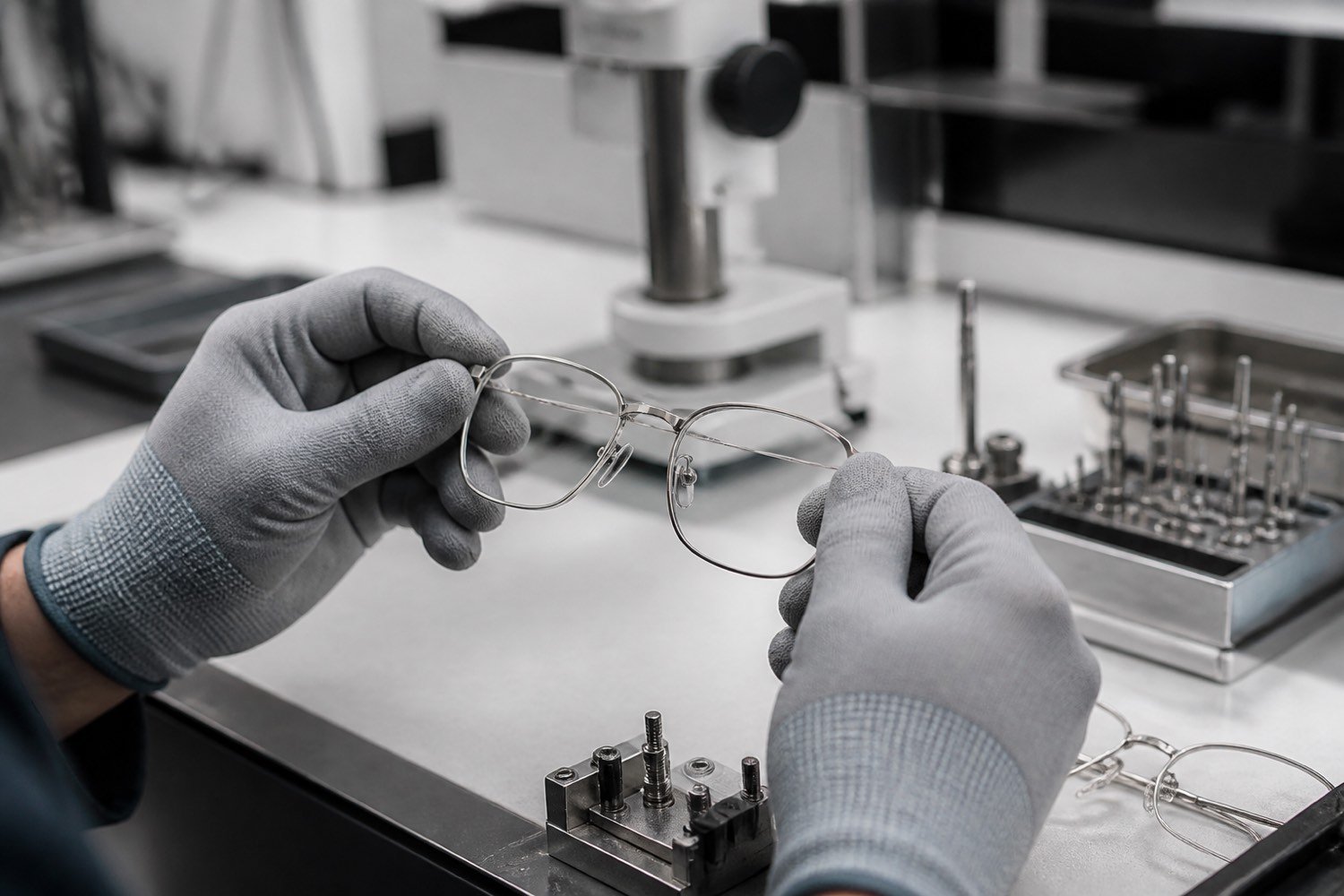
The process depends on whether the design uses sheet, wire, bar, cast parts, or machined components. Most programs combine several methods rather than relying on one magical titanium machine.
1. Design and engineering review
Manufacturing begins with frame dimensions, lens shape, material callouts, target weight, hinge system, finish, and tolerance requirements. Engineers review thin sections, sharp bends, joint locations, and surfaces that will receive color or texture.
This stage should also identify mixed-metal contacts. Different metals, joining materials, and coatings can change corrosion behavior and finishing results.
2. Cutting, forming, and machining
Manufacturers may cut profiles from sheet, form wire and temples, stamp components, or machine bridges, hinges, and decorative parts. Titanium tends to spring back after forming, so tooling and process settings must compensate for the material rather than copy a recipe developed for stainless steel.
Complex parts may require several forming steps with inspections between them. The aim is not merely to match the drawing once. The process must hold shape across a production lot.
3. Joining
Frame components may be joined through laser welding, brazing with suitable filler systems, mechanical fastening, or a combination of methods. Titanium reacts readily at elevated temperatures, so heat input and shielding need careful control.
A clean joint affects more than appearance. Excess heat, contamination, or poor alignment can weaken a thin component and create rework later in assembly.
4. Surface preparation and finishing
Polishing, brushing, blasting, coloring, and physical vapor deposition (PVD) can create very different appearances. Surface preparation affects adhesion and consistency, especially along edges, weld areas, and tight corners.
Approve finish samples under controlled lighting. A color name such as “gunmetal” is subjective. A signed master sample and measurable color range are far more useful.
5. Assembly and adjustment
The factory installs hinges, screws, nose pads, temple tips, demo lenses, and decorative components before final adjustment. Inspectors then check frame plane, temple opening, pantoscopic angle, bridge symmetry, and screw function.
You can review the broader sequence on our eyewear manufacturing page and explore options for OEM eyeglass frame manufacturing.
What Should Buyers Check Before Production?
A strong purchase specification converts broad material language into evidence and measurable acceptance criteria.
Confirm the material by component
Request a bill of materials that identifies the front, bridge, temples, hinges, screws, nose-pad arms, and decorative parts. Match critical titanium components to material declarations or certificates from the material supplier.
If your marketing will say “pure titanium” or “nickel-free,” define what that claim covers. The front only? All skin-contact metal? Every metal component? Clear scope prevents ambitious packaging from outrunning the evidence.
Define dimensions and alignment
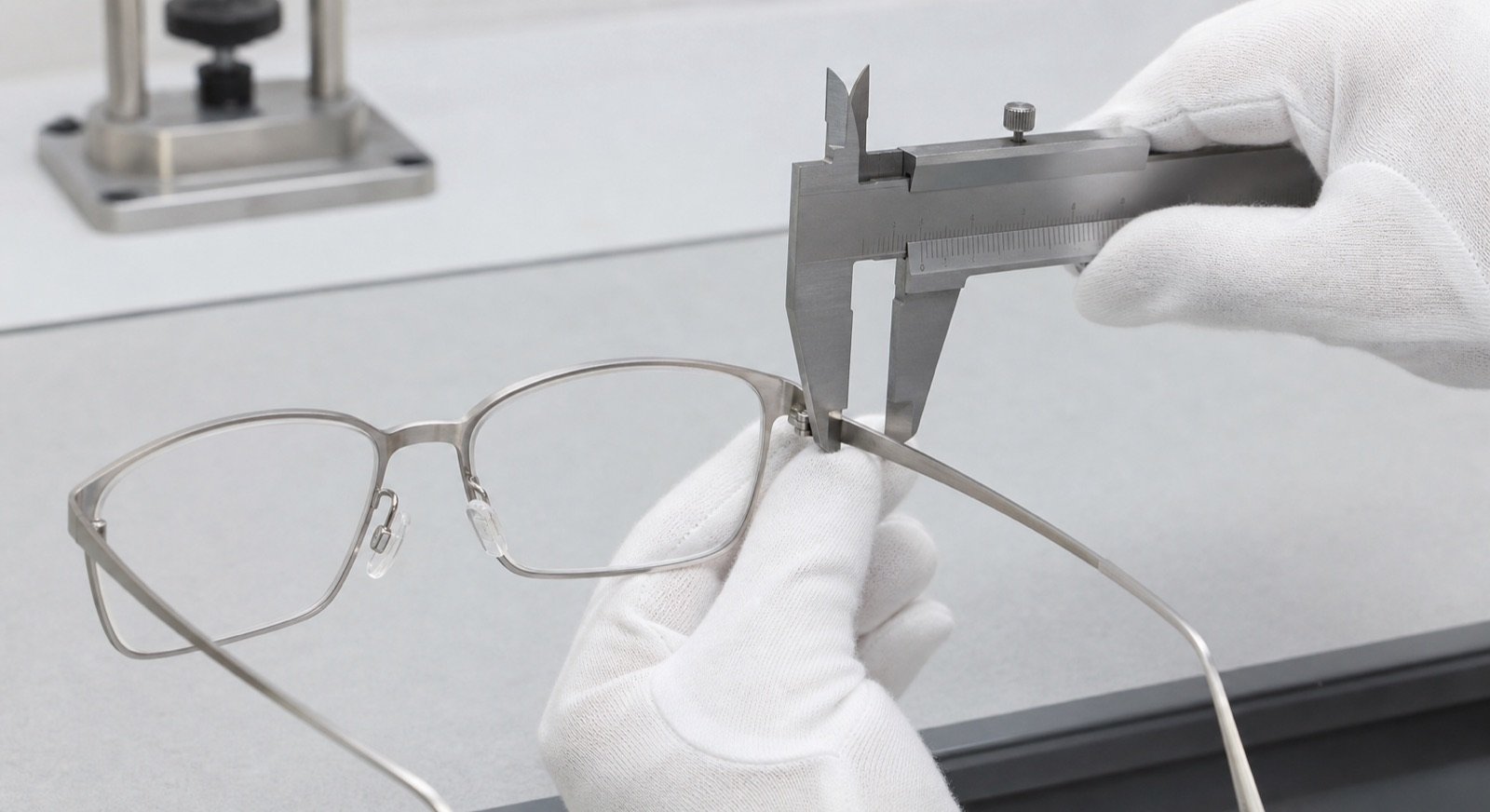
Use an approved drawing with tolerances for lens width, bridge, temple length, frame width, rim geometry, hinge position, and key angles. Add an approved physical sample when feel and adjustment matter.
Check more than isolated dimensions. A frame can meet individual measurements and still sit twisted if the relationship between those measurements is wrong.
Test the finished frame
Relevant checks may include dimensional stability, bridge deformation, lens retention, temple endurance, screw function, perspiration resistance, coating adhesion, and corrosion performance. ISO 12870 provides requirements and test methods for spectacle frames, but your test plan must also reflect the destination market, product claims, and customer specification.
Our quality control overview explains how quality planning fits into frame production.
Lock the finish standard
Keep signed color and texture masters. Define acceptable shade variation, gloss, brushing direction, edge coverage, and visible defects. If the design combines titanium with other metals or polymers, approve the complete assembled appearance.
Approve a production-representative sample
A hand-finished prototype can prove the design, but it may not represent normal production. Before the full order, review a sample made with the intended material, tooling, joining process, finish, and assembly components.
How Do You Choose the Right Titanium Frame Specification?
Start with the user and the product position. A minimalist optical frame, flexible children’s style, fashion sun frame, and rimless executive design do not need the same titanium material or test plan.
Use this sequence:
- Define the wear case. Set comfort, durability, adjustment, and styling priorities.
- Choose material by component. Do not force one alloy into every part.
- Set measurable performance. Define flex, recovery, dimensions, finish, and test expectations.
- Map compliance needs. Include market-specific chemical, labeling, and frame requirements.
- Review tooling and order quantity. Confirm how MOQ, tooling, finishing, and sample rounds affect cost and timing.
- Approve evidence. Sign drawings, material records, finish masters, and representative samples before mass production.
This approach may feel less exciting than choosing a finish from a color card. It is also how you avoid discovering a material mismatch after several thousand temples have been coated.
Frequently Asked Questions About Titanium Eyewear
Is all titanium eyewear made from pure titanium?
No. A frame may use commercially pure titanium, beta titanium, another titanium alloy, or a mix of titanium and non-titanium components. Confirm the bill of materials and the material used in each major part.
What is the difference between pure titanium and beta titanium eyewear?
Commercially pure titanium is often chosen for low weight, corrosion resistance, and a clean metal finish. Beta titanium alloys are often selected when a design needs more elastic flexibility. Exact behavior depends on grade, geometry, and processing.
Does titanium eyewear rust?
Titanium has strong corrosion resistance because of its protective surface oxide. However, a finished frame may include other metals, joints, and coatings. Test the assembled product for its intended environment.
Is titanium eyewear suitable for people with nickel sensitivity?
It can be a useful starting point, but the word “titanium” does not prove that every component is nickel-free or that nickel release meets a specific limit. Verify all skin-contact parts and test the finished frame for the target market.
Is beta titanium always better than pure titanium?
No. Beta titanium can be valuable for flexible components, while commercially pure titanium may suit designs that prioritize low weight, corrosion resistance, or a particular finish. The better choice is the one that meets the drawing and wear requirements.
Build the Material Claim Into the Specification
Titanium eyewear can deliver a light, refined, and durable product, but only when the material claim is tied to specific components and measurable performance. Define the alloy, geometry, joining method, finish, and test plan before production. Then verify the complete frame rather than relying on a label.
If you are developing a titanium optical or sunglass collection, review our titanium eyeglass frame capabilities or contact our team with your drawings, target market, and material questions.