
What Is PVD Coating on Titanium Eyeglass Frames?
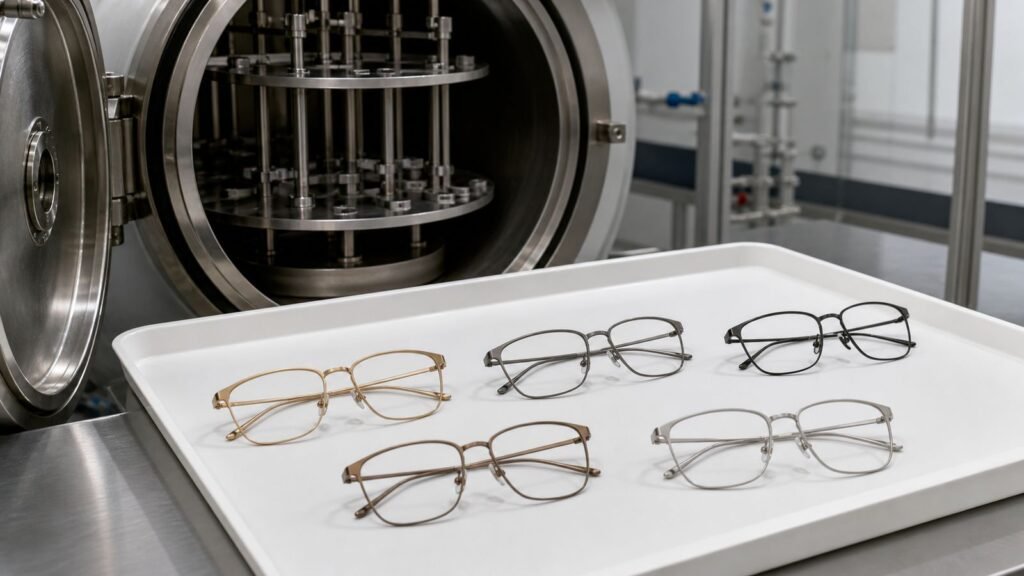
PVD coating on titanium eyeglass frames is a vacuum process that deposits a thin decorative or functional film onto prepared frame parts. Manufacturers use it to create colors such as gold, gray, black, and other controlled metallic tones. The coating can also change surface hardness, friction, and wear behavior, depending on its composition and structure. It does not repair a rough substrate or make a weak frame strong. Adhesion starts with cleaning, surface preparation, racking, and a stable deposition recipe. This guide explains the process and the checks buyers should put in the specification.
What does PVD mean?
PVD stands for physical vapor deposition. A coating material moves from a solid source into a vapor and then condenses onto parts inside a vacuum chamber. The film builds on the surface atom by atom.
Common PVD source methods include evaporation, sputtering, and cathodic arc deposition. Each method creates and moves vapor differently. Reactive gases can combine with the source material to form compounds such as nitrides, oxides, or carbon-based films.
The US Environmental Protection Agency describes PVD as a broad class of vacuum coating processes. Material leaves a source through evaporation or sputtering and travels through a vacuum or partial vacuum. That definition is more useful than treating PVD as one mysterious black recipe. See the EPA's metal-finishing technology guide.
PVD tells you how a coating reaches the frame. It does not tell you the coating chemistry, layer count, thickness, color tolerance, or performance. Those details belong in the finish specification.
Why apply PVD to a titanium eyeglass frame?
Decorative color
PVD can give titanium parts a metallic color while preserving fine surface details. Titanium nitride is associated with gold tones. Other target materials and reactive gases can produce gray, pale gold, bronze, black, or related finishes.
Commercial color names are not chemical specifications. Two suppliers may both call a finish "gunmetal" while using different coating stacks and producing different hues. Ask for the approved code, physical reference sample, and measurable color limits.
Surface behavior
Some PVD coatings are harder than the titanium substrate and can improve resistance to selected wear mechanisms. The result depends on the coating material, structure, adhesion, thickness, surface roughness, and load.
Hardness does not mean scratch proof. Sand, metal tools, repeated hinge contact, or enough substrate bending can still damage a hard film. A thin hard coating over a flexible part is a team, not a superhero.
A thin finish that follows the part
PVD films are thin compared with many paint systems. They can preserve logos, edge definitions, and precision features when the coating allowance is included in the design.
The film follows the surface underneath. A polished frame tends to stay visually bright. A blasted or brushed frame remains more diffuse. PVD will not fill polishing pits, weld marks, or deep scratches. The vacuum chamber is not Photoshop.
PVD is not the same as anodizing, electroplating, or paint
| Finish method | How the finish forms | Typical visual character | Main buyer question |
|---|---|---|---|
| PVD | Material deposits from vapor in a vacuum or partial vacuum | Thin metallic or ceramic-like film | What chemistry, layer stack, thickness, and process route are specified? |
| Titanium anodizing | An electrochemical process changes the surface oxide | Interference colors without a deposited pigment layer | What voltage, preparation, and color tolerance control the oxide? |
| Electroplating | Metal deposits from an electrolyte using an electrical process | Metallic layer that can include several underlayers | Which metals and underlayers are present? |
| Wet paint or lacquer | A liquid coating cures on the surface | Broad color range, including opaque and translucent effects | Which resin, cure, thickness, and adhesion system are used? |
| Powder coating | Charged powder melts and cures into a film | Usually thicker and more covering | Can the design tolerate the film build and cure temperature? |
A finished frame can combine processes. A manufacturer might polish titanium, apply PVD, and add a selective clear topcoat or printed detail. The bill of materials should record the complete system, not only the most marketable acronym.
Common PVD coating types and colors
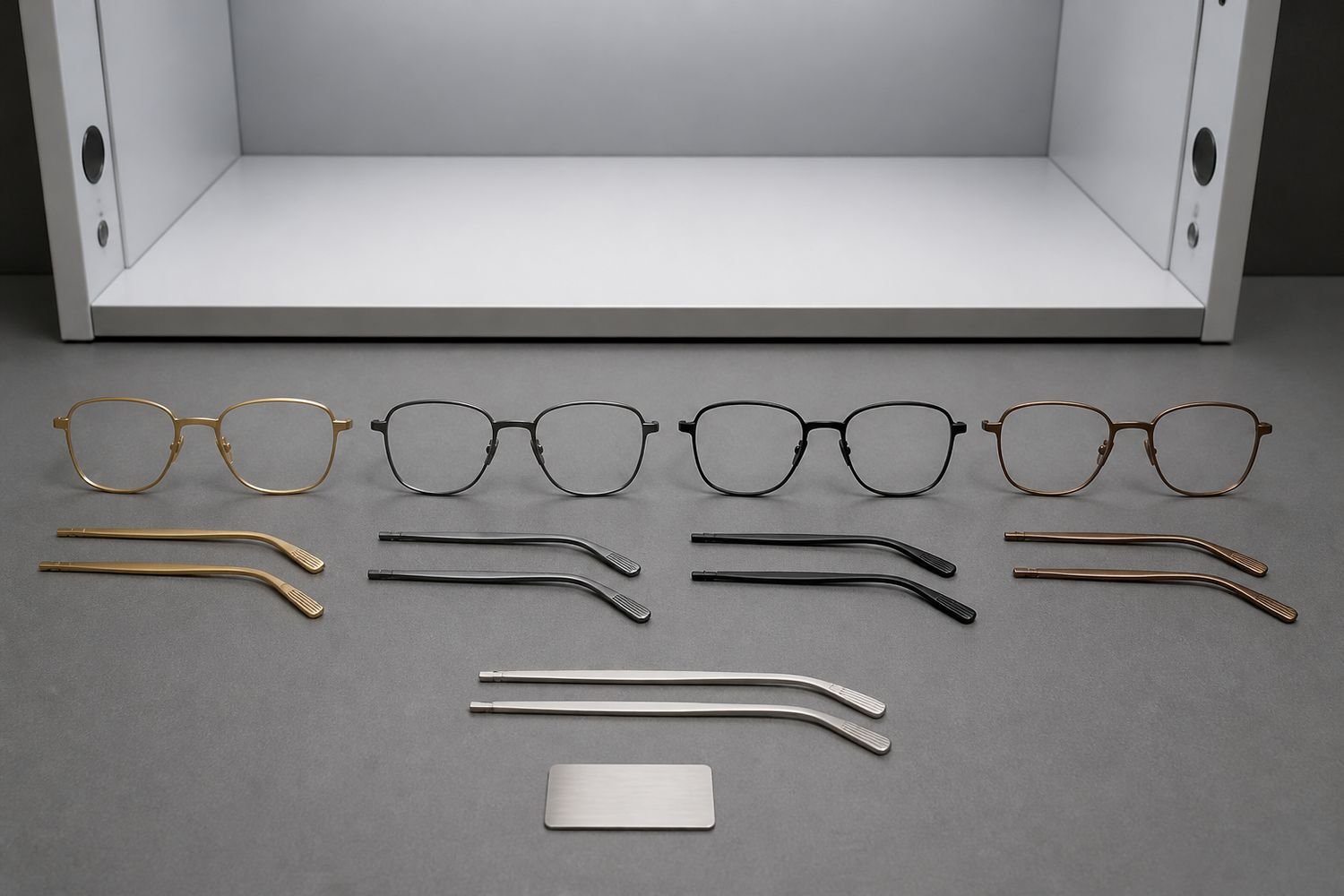
The coating name should match the actual supplier recipe and test record. The examples below describe common associations, not guaranteed eyewear formulas.
| Coating family | Common appearance | Why it may be selected | Important limitation |
|---|---|---|---|
| Titanium nitride based | Gold to yellow-gold | Metallic gold color and hard surface | Hue changes with recipe, thickness, texture, and lighting |
| Zirconium nitride based | Pale gold to warm metallic tones | Alternative gold-family color and wear behavior | The commercial name does not prove composition |
| Chromium nitride based | Silver-gray to darker gray | Neutral metallic appearance and hard surface | A chromium-containing film is not the same as decorative chrome plating |
| Carbon-based or DLC-family | Gray to black | Dark color, low-friction or wear goals in suitable systems | "DLC" covers several structures and properties, not one universal film |
| Multilayer or mixed compound | Bronze, rose, gray, black, or custom tones | Color tuning and layer-specific functions | More interfaces and recipe variables require tighter control |
ISO 21874:2019 describes evaluation of composition, structure, and properties for multilayer PVD hard coatings. It defines common PVD as vacuum deposition using evaporation, sputtering, or related non-chemical source methods.
Do not infer performance from color. A black film is not automatically DLC, and a gold frame is not automatically titanium nitride. Request the coating designation and the evidence required for the product claim.
How PVD coating is applied to titanium eyewear
1. Review the frame material and design
The coating supplier needs the titanium grade, component list, target finish, and any non-titanium parts that will enter the chamber. Springs, solder, adhesives, plastics, rubber, magnets, or assembled hinges may not tolerate the heat, vacuum, cleaning, or plasma conditions.
The design review also marks lens grooves, screw threads, electrical contact points, moving interfaces, and surfaces that need masking. A fully assembled frame may coat differently from separate fronts and temples.
Our guides to titanium eyewear and titanium alloy eyewear explain why the grade and component construction should be known before finishing.
2. Create the substrate finish
Polishing, brushing, blasting, tumbling, and other mechanical operations establish the texture that the coating will follow. The factory should approve this appearance before PVD.
Over-polishing can round edges, thin a rim, or change logo depth. Incomplete polishing can leave scratches that become more obvious after a reflective coating. Inspect the uncoated parts under controlled lighting before loading the chamber.
3. Clean and dry every surface
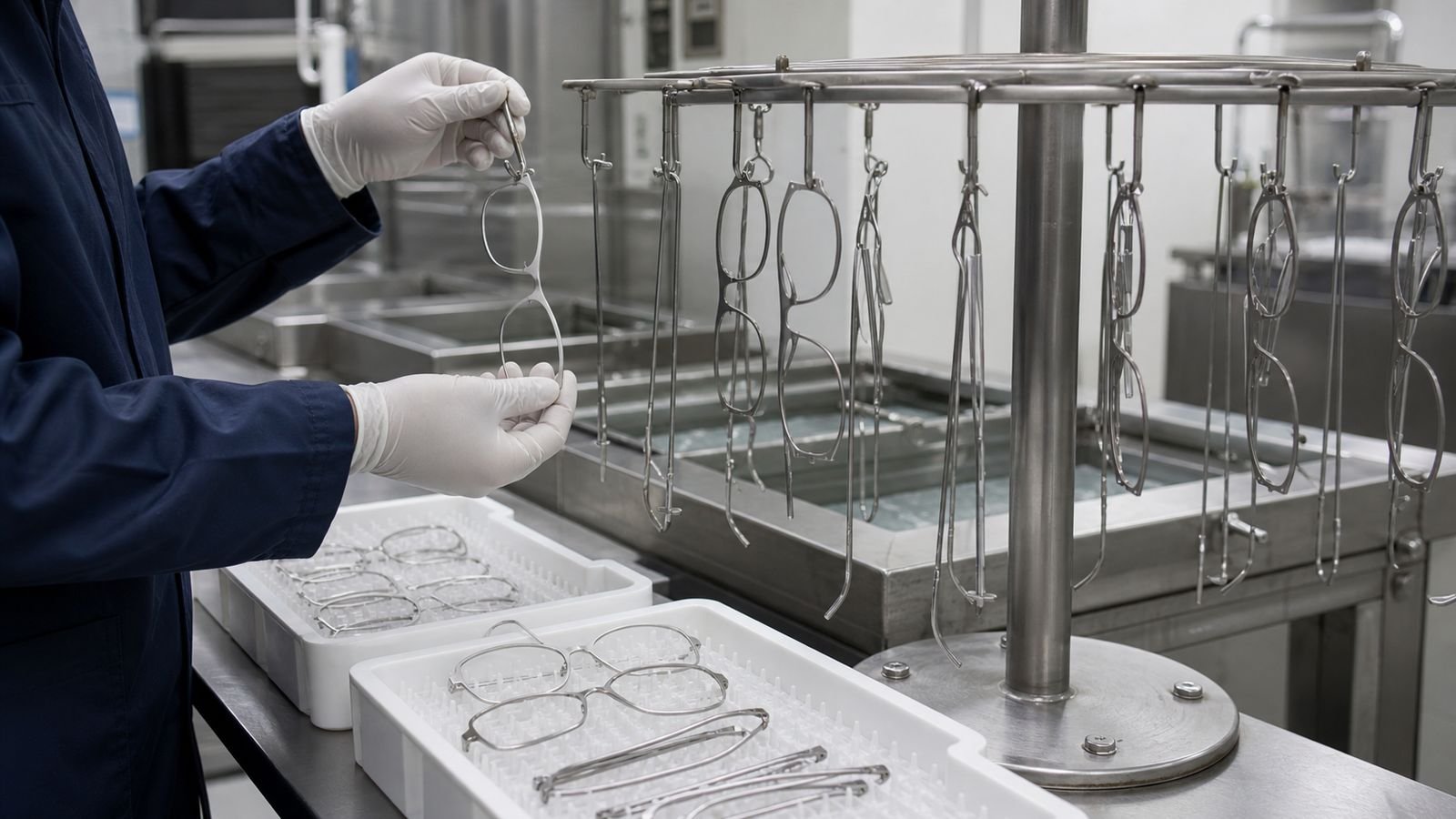
Oil, polishing compound, fingerprints, dust, oxide residue, and rinse marks interfere with deposition and adhesion. A typical route can include aqueous cleaning, ultrasonic cleaning, rinsing, and thorough drying. The correct chemistry depends on the material and prior operations.
Clean parts need clean handling and storage. A white glove is not a magic shield if it has spent the morning touching oily door handles.
4. Mask and rack the parts
Fixtures hold the parts, carry any required electrical bias, and move them through the vapor flux. Contact points leave small uncoated or differently coated areas. The specification should place those marks where they will not affect appearance, skin contact, corrosion, or assembly.
Masking protects threads, bearing surfaces, lens interfaces, logos, or electrical contacts when needed. Masks must survive the process without outgassing or contaminating the chamber.
Part spacing and orientation affect coverage. PVD is strongly directional in many systems. Deep recesses, hidden backs, close overlaps, and complex hinge geometry can receive less coating unless the fixture rotates or the source arrangement compensates.
5. Pump down and plasma-clean
The chamber removes air and moisture to reach the required vacuum. The process may heat parts within a controlled range and use ion or plasma bombardment to clean and activate the surface.
This in-chamber preparation does not excuse poor cleaning outside the chamber. Plasma cleaning can remove selected surface contamination. It cannot reliably turn trapped polishing compound into a good bonding surface.
6. Deposit the coating
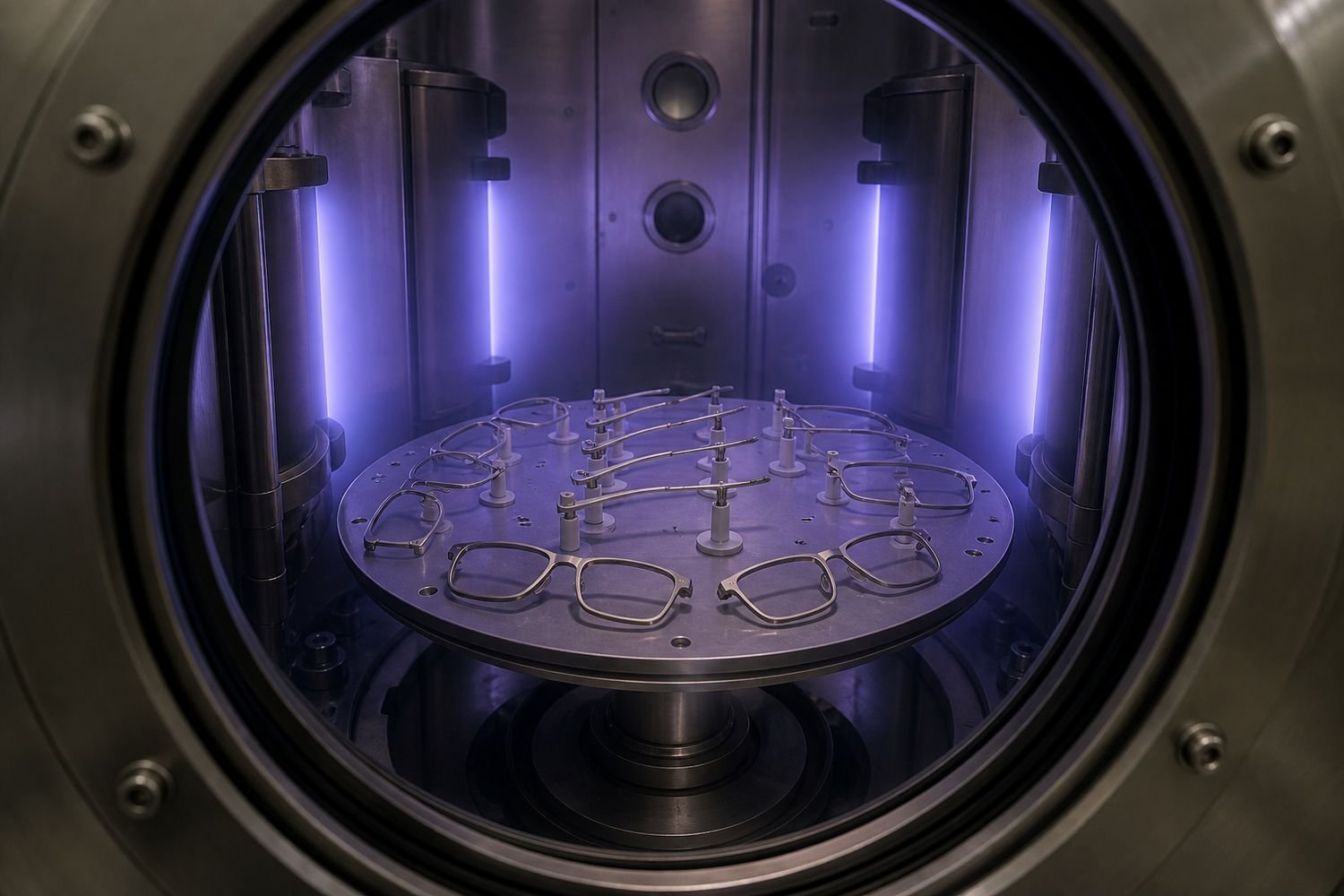
The system vaporizes or sputters material from the source. The vapor reaches the rotating or moving frame parts and condenses into a film. Reactive gas, substrate bias, temperature, source power, pressure, time, and fixture motion help control the result.
Some recipes use an adhesion layer, color layer, and protective top layer. Others use a single compound or a graded structure. The approved stack should appear in controlled supplier records even when the commercial formulation remains confidential.
7. Cool, unload, and inspect
The chamber completes its cycle, the parts cool as required, and operators unload them with clean handling. Inspection should look for color drift, stains, particles, pinholes, thin zones, flaking, arc droplets, rack marks, and damage from handling.
The frame may then return for assembly, laser marking, topcoat, adjustment, or final cleaning. Any later operation can scratch or stress the coating, so the process plan must protect finished surfaces.
What controls PVD adhesion on titanium?
Surface cleanliness
Adhesion fails quickly when oil, compound, moisture, dust, or an unstable surface layer remains between film and substrate. Cleaning records and contamination controls deserve as much attention as the deposition recipe.
Surface texture
Roughness changes mechanical contact, local film growth, and appearance. Too smooth, too rough, or simply inconsistent may cause problems for a specific coating. The supplier should qualify the same substrate finish used in production.
In-chamber surface activation
Ion etching or plasma cleaning can remove weak surface material and prepare the titanium before deposition. Excessive treatment can also change texture or heat the part. The validated recipe sets the useful window.
Interlayers and coating stress
An interlayer can improve bonding or manage the transition between substrate and hard film. Internal stress in the coating can promote cracking or delamination when the layer, temperature, or bias moves outside the process window.
Part temperature and substrate movement
Deposition temperature affects film formation and the frame components already assembled. The supplier must keep the process within limits for the titanium condition, joints, hardware, and other materials.
Thin temples and rims can flex in use. If the substrate strains beyond what the coating system tolerates, the hard film can crack even when its initial adhesion was good.
Common PVD coating defects on eyeglass frames
Peeling or flaking
Visible film lifts from the substrate. Contamination, weak preparation, high coating stress, an unsuitable interlayer, or excessive substrate deformation can contribute. Recoating over the loose area is not a durable repair.
Pinholes and particles
Dust, droplets, surface pits, or process contamination can create small raised points and openings. Pinholes can expose an underlayer or substrate and become sites for cosmetic corrosion.
Thin or missing coverage
Shadowed recesses, hinge backs, overlaps, and poor rack orientation may receive less film. Check hidden areas and moving joints, not only the easiest front surface.
Color variation
Hue can shift with coating composition, thickness, gas control, source condition, substrate texture, fixture position, chamber load, and measurement angle. A front and temple coated in different loads may not match.
Scratches and wear-through
Handling tools, assembly, lens fitting, hinge movement, and wearer contact can damage the finish. Wear at a moving interface is different from adhesion failure, though the final appearance may look similar.
Rack and mask marks
Every part needs support and often an electrical path. The rack contact area can remain uncoated. Buyers should approve its position and acceptable size rather than discover it on a shipment.
Does PVD make titanium frames scratch proof?
No. A hard PVD film can resist some wear better than bare or softly coated metal, but scratch behavior is a system property. It depends on the film, substrate hardness, film thickness, adhesion, contact shape, load, abrasive particle, and frame flex.
A hard brittle film over a thin flexible temple may crack when the temple bends. A soft particle may polish the surface, while a sharp hard particle cuts through it. Marketing words such as "diamond hard" do not define the actual test.
Specify the wear event that matters. Temple-to-front rubbing, screw-tool contact, nose-pad movement, lens insertion, and loose frames in a handbag are different problems and need different checks.
How to specify PVD color and appearance
Approve a physical master sample
A signed sample shows texture, gloss, color, and acceptable visual variation better than a screen image. Keep matching masters with the buyer and coating supplier. Record the coating code, substrate finish, date, and revision.
Define controlled viewing conditions
Metallic finishes change with angle and lighting. State the light source, viewing geometry, background, inspection distance, and surfaces to inspect. Cosmetic zones should be separated from hidden or contact zones.
Use color measurement carefully
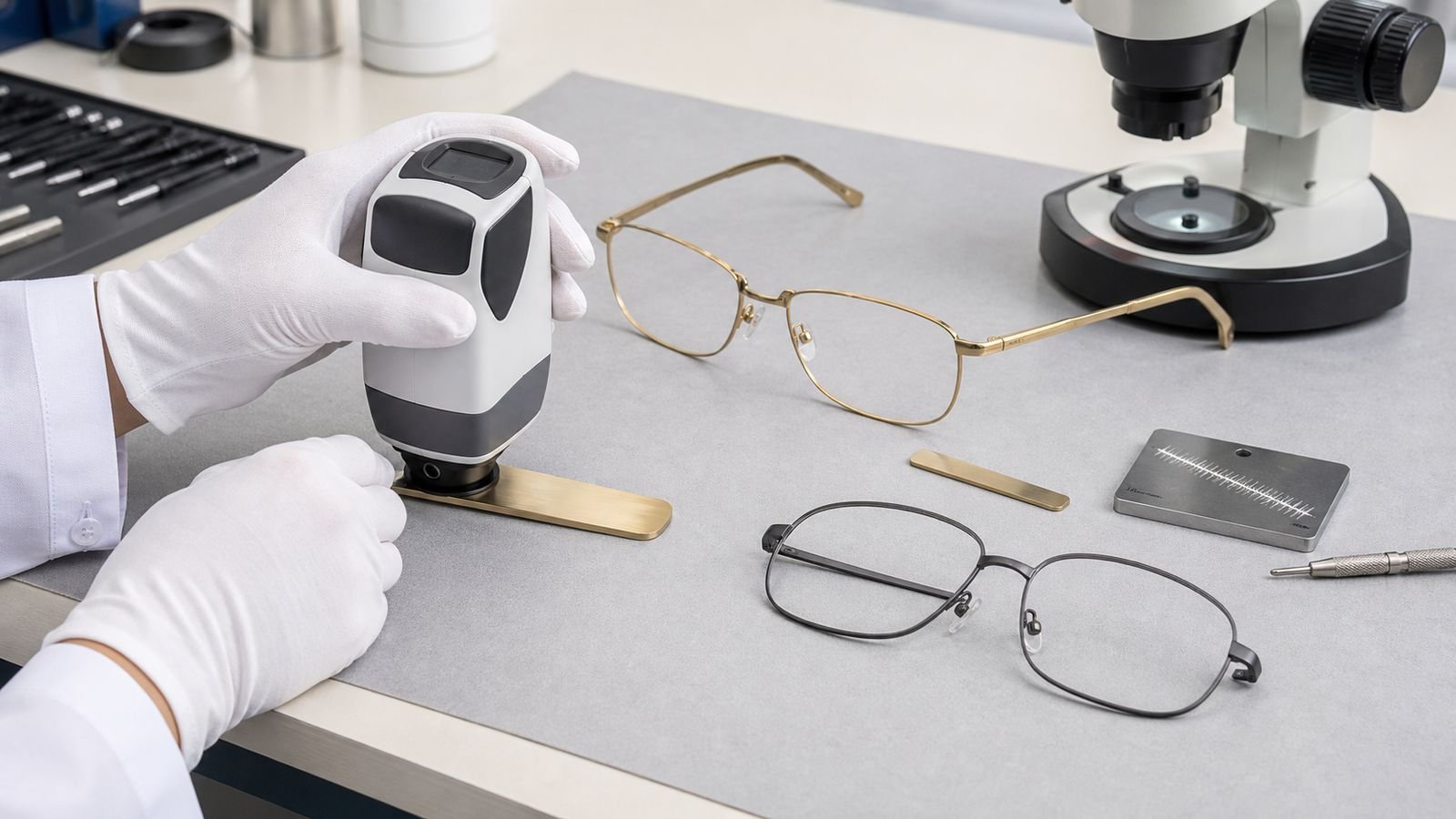
A spectrophotometer can report color coordinates and differences, but curved metal parts create measurement problems. Define the instrument geometry, aperture, illuminant, observer, orientation, and exact measurement locations.
ISO/CIE 11664-4:2019 defines the CIE Lab* color space and methods for calculating color differences. It does not choose an acceptable tolerance for a titanium frame. Buyer and supplier must set that limit with the approved visual sample and capable measurement setup.
Control lot-to-lot matching
Record whether fronts and temples must be coated in the same chamber load. If separate loads are allowed, set matching rules. Retain production samples so a later color complaint can be compared with the actual approved lot.
How to test a PVD-coated titanium frame
Visual and dimensional checks
Inspect appearance under controlled light before and after assembly. Check coating buildup or masking at threads, hinges, grooves, holes, and other interfaces. Confirm the frame still meets its controlled dimensions.
Coating thickness
The specification should state the required thickness or supplier-controlled range where thickness affects function. Cross-sections, X-ray methods, calibrated witness coupons, or other methods may be suitable depending on coating chemistry, substrate, geometry, and available equipment.
A flat witness coupon is easier to measure than a curved rim. It proves the coupon's result, not automatic coverage on every shadowed frame surface. Correlate coupons with representative product locations during qualification.
Adhesion
Scratch, indentation, bend, tape, or other adhesion-related methods stress coatings in different ways. Select a method that suits the hard film, thickness, substrate, and part geometry.
ISO 20502:2005 describes a diamond-stylus scratch method for ceramic coatings up to 20 micrometers and may suit other coatings with proper calibration. The method is currently published but marked for revision. It should not be named on a purchase order until the supplier confirms that the coating and test piece fit its scope.
Wear and abrasion
Define the counter-material, force, motion, cycle count, area, cleaning method, and failure criterion. A vague "abrasion test passed" cannot be repeated. Product-specific hinge or temple-rub fixtures may reveal more than a generic flat-panel test.
Corrosion and perspiration exposure
Test the complete coating system, including pores, rack marks, underlayers, mixed metals, and post-coating assembly. The exposure and pass criteria should match the intended product and market.
ISO 9227:2022 specifies salt-spray apparatus and procedures but does not select specimen type, exposure time, or result interpretation for an eyewear product. It also warns against using salt spray to rank materials or predict long-term corrosion. Do not turn an arbitrary hour count into a service-life promise.
Finished-frame testing
ISO 12870:2024 specifies fundamental requirements and test methods for unglazed spectacle frames intended for prescription lenses. Coating checks do not replace finished-frame tests for the assembled product.
Our eyeglass frame quality-control guide explains how incoming material, process inspection, and final testing connect.
Is PVD coating nickel-free or hypoallergenic?
PVD does not prove either claim. The decorative film may not contain intentionally added nickel, yet an adhesion layer, plated underlayer, hinge, screw, solder, nose-pad component, or exposed rack mark may contain it. Wear can also expose material beneath the coating.
A "hypoallergenic" claim needs a defined basis and target-market review. Buyers should specify materials by component and test the finished product where release limits apply. The coating name alone is not enough.
This distinction matters even on a pure titanium eyeglass frame. A pure titanium front does not turn every attached or coated component into pure titanium.
What drives PVD coating cost?
Surface preparation
Polishing, blasting, cleaning, and rework often consume more labor than the visible deposition step suggests. Cosmetic grades with tight scratch limits require better incoming parts and more inspection.
Chamber load and racking density
A chamber cycle has fixed setup and pump-down time. Part size, orientation, spacing, and fixture motion decide how many frames fit without creating shadowed coverage.
Masking and handling
Selective coating, protected threads, moving joints, and delicate cosmetic surfaces add manual work. Complex masking can reduce load density and increase defect risk.
Coating chemistry and stack
Target material, reactive gas, layer count, deposition time, temperature, and licensed or proprietary recipes affect cost. A dark multilayer finish may not share the same cycle as a basic gold tone.
Color tolerance and lot size
Tighter color matching needs more process control, measurement, retained samples, and sometimes dedicated loads. Small lots spread setup and qualification across fewer frames.
Testing and rejection risk
Thickness, adhesion, wear, corrosion, color, and product tests add direct cost. A failed load may require stripping, re-polishing, or scrapping parts. The quotation should state who pays when incoming surface defects cause rejection.
Include these items in the wider OEM eyewear manufacturing quote instead of comparing only a per-frame coating surcharge.
Buyer checklist for PVD-coated titanium eyewear
Before quotation
- Identify the titanium grade and every non-titanium component entering the chamber.
- Define the coating family, commercial code, layer stack, and permitted underlayers.
- State substrate texture, gloss, color, cosmetic zones, and mask locations.
- Mark moving interfaces, threads, lens features, logos, and skin-contact areas.
- Set order quantity, color split, and whether components must share a chamber load.
During sample approval
- Approve an uncoated surface sample before PVD.
- Approve coated physical masters for each texture and color.
- Record cleaning, racking, contact points, chamber recipe, and process revision.
- Validate representative coverage on recesses, hinges, and hidden surfaces.
- Agree on color, thickness, adhesion, wear, corrosion, and frame-level tests.
- Check the coating after assembly, adjustment, and lens-fitting simulation.
During production
- Match material, polish, coating, and drawing revisions to the approved sample.
- Inspect incoming polished parts before chamber loading.
- Control rack condition, source condition, chamber cleanliness, and process records.
- Measure defined product locations and qualified witness coupons.
- Retain samples by lot and record any approved repair or recoating.
- Require written approval before changing the supplier, recipe, underlayer, topcoat, or fixture.
Frequently asked questions
Can PVD coating peel from titanium?
Yes. Good preparation and a compatible recipe can produce strong adhesion, but contamination, coating stress, poor activation, substrate flex, or an unsuitable layer stack can cause peeling. Test the real substrate finish and geometry.
How thick is PVD on an eyeglass frame?
There is no universal thickness. The value depends on the coating family, layer structure, color, equipment, and performance target. Ask for the specified range, measurement method, and locations instead of relying on a generic internet number.
Does PVD color fade?
The film may be stable under one exposure yet change because of wear, chemicals, heat, corrosion at defects, or a separate topcoat. Define the expected environment and test the complete finish system.
Can PVD hide scratches or welding marks?
No. A thin PVD film follows the substrate and can make reflective defects easier to see. Finish and inspect polishing and laser-welded joints before coating.
Can a PVD-coated frame be recoated?
Sometimes, but the old film usually needs a qualified stripping and refinishing route. Stripping, polishing, and another coating cycle can change dimensions, texture, joint condition, or color. The supplier should approve the repair route and repeat the required tests.
Is PVD environmentally friendly?
PVD is a dry vacuum process and can avoid some liquid plating baths. Its footprint still includes electricity, vacuum equipment, target materials, cleaning chemistry, gases, rejected parts, and maintenance waste. Compare the complete process and local controls before making an environmental claim.
Specify the finish as a system
PVD can give titanium eyewear a thin, controlled metallic finish with useful surface properties. A reliable result depends on the substrate texture, cleaning, racking, chamber recipe, layer stack, handling, and product-level tests. Put those details in the specification, then approve samples that came from the intended production route.
Developing a coated titanium frame? Review our titanium eyeglass frame capabilities or contact us with your drawings, target color, surface texture, component list, quantities, and test requirements for a structured feasibility review.