
What Is Laser Welding in Titanium Eyewear Manufacturing?
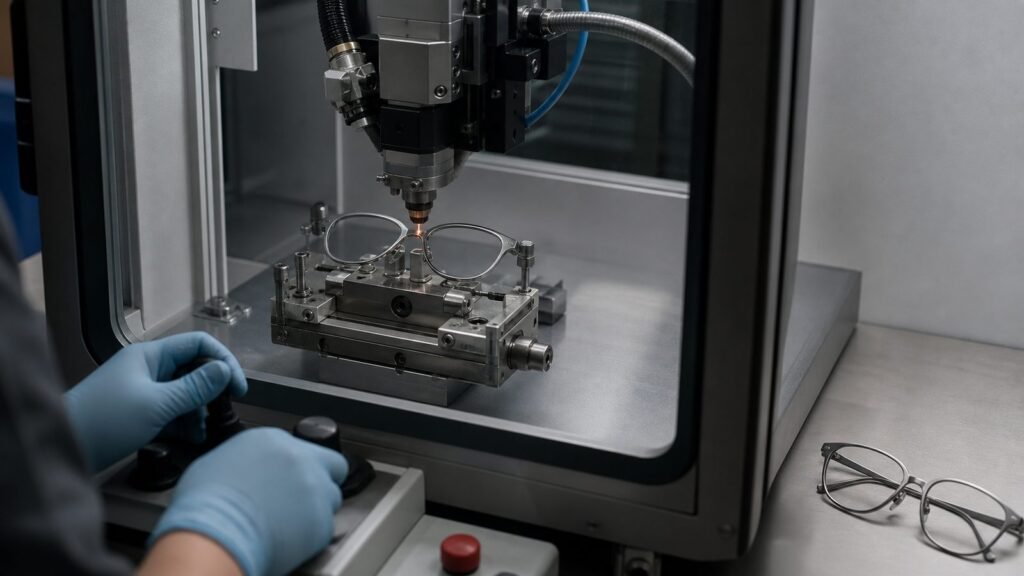
Laser welding in titanium eyewear manufacturing uses a focused beam to melt and join small frame components. It can attach bridges, end pieces, hinge blocks, nose-pad arms, and decorative details with a narrow, controlled heat source. The process suits thin parts and compact joints, but the laser does not make titanium easy to weld. Joint fit, surface cleanliness, focus, shielding gas, fixtures, and inspection still decide whether a weld survives finishing and daily wear. A neat bead can hide pores or poor fusion underneath. This guide explains the process, its limits, and the records buyers should request.
What is laser welding?
Laser welding directs concentrated light onto a joint. The material absorbs the energy, heats, and melts in a small local area. When the molten metal solidifies, it forms the weld.
The machine may deliver energy as individual pulses or a continuous beam. Pulsed operation gives the programmer control over each small weld spot. Continuous or modulated operation can create a seam as the beam or part moves. The useful choice depends on material thickness, joint shape, penetration, speed, and equipment.
Laser welding is a fusion process. It differs from laser brazing or soldering, where a lower-melting filler joins parts without fully melting the base materials. It also differs from laser cutting, even if the same factory uses both processes.
In practice, the laser source is only one part of the system. Optics focus the beam. A fixture locates the frame parts. Motion hardware controls the weld path. Inert gas protects hot titanium, and the controller stores the validated settings. Calling the laser "automatic" does not remove the need for a capable process engineer.
Where is laser welding used on titanium eyeglass frames?
Manufacturers may use laser welding for:
- joining a bridge to two rims or front sections;
- attaching end pieces or hinge blocks to a front;
- joining hinges or small fittings to temples;
- attaching titanium nose-pad arms;
- closing a seam in a formed or machined component;
- adding a small titanium detail where access allows shielding and inspection.
The complete frame rarely comes from laser welding alone. A production route may combine CNC machining, forming, laser cutting, laser welding, polishing, coating, assembly, and adjustment.
Ask for a component-level process map. "Laser welded frame" does not tell you which joints were welded, whether filler was used, or how those joints were tested.
Why manufacturers choose laser welding for titanium eyewear
Concentrated heat
A focused laser can put heat into a small joint instead of warming a large area. This can produce a narrow weld and a relatively small heat-affected zone, often shortened to HAZ. The HAZ is the unmelted material next to the weld whose microstructure or properties changed because of heat.
Lower total heat input can reduce distortion on thin fronts and temples. It does not guarantee zero distortion. A poorly balanced weld sequence or weak fixture can still pull a frame out of alignment.
Access to small features
The beam can reach compact joints that are awkward for a larger torch. This helps with small hinge parts, nose-pad arms, and joints close to cosmetic surfaces. The line of sight, focus angle, gas nozzle, and fixture must all fit around the same joint.
Repeatable programs
Once the factory validates the fixture, focus, beam path, pulse settings, shielding, and part preparation, it can store and repeat the process. Repeatability is useful only while the inputs remain controlled. A new material lot, larger joint gap, dirty optic, or moved fixture can shift the result.
Limited filler and finishing for suitable joints
Some joints can be welded autogenously, which means without filler wire. That can reduce extra material and leave a compact bead. Other joints need filler to bridge a gap, change weld chemistry, or build the required section.
Autogenous is not automatically better. If the joint needs filler, pretending the gap is optional usually creates a very expensive way to make tiny holes.
Why titanium laser welding needs careful shielding
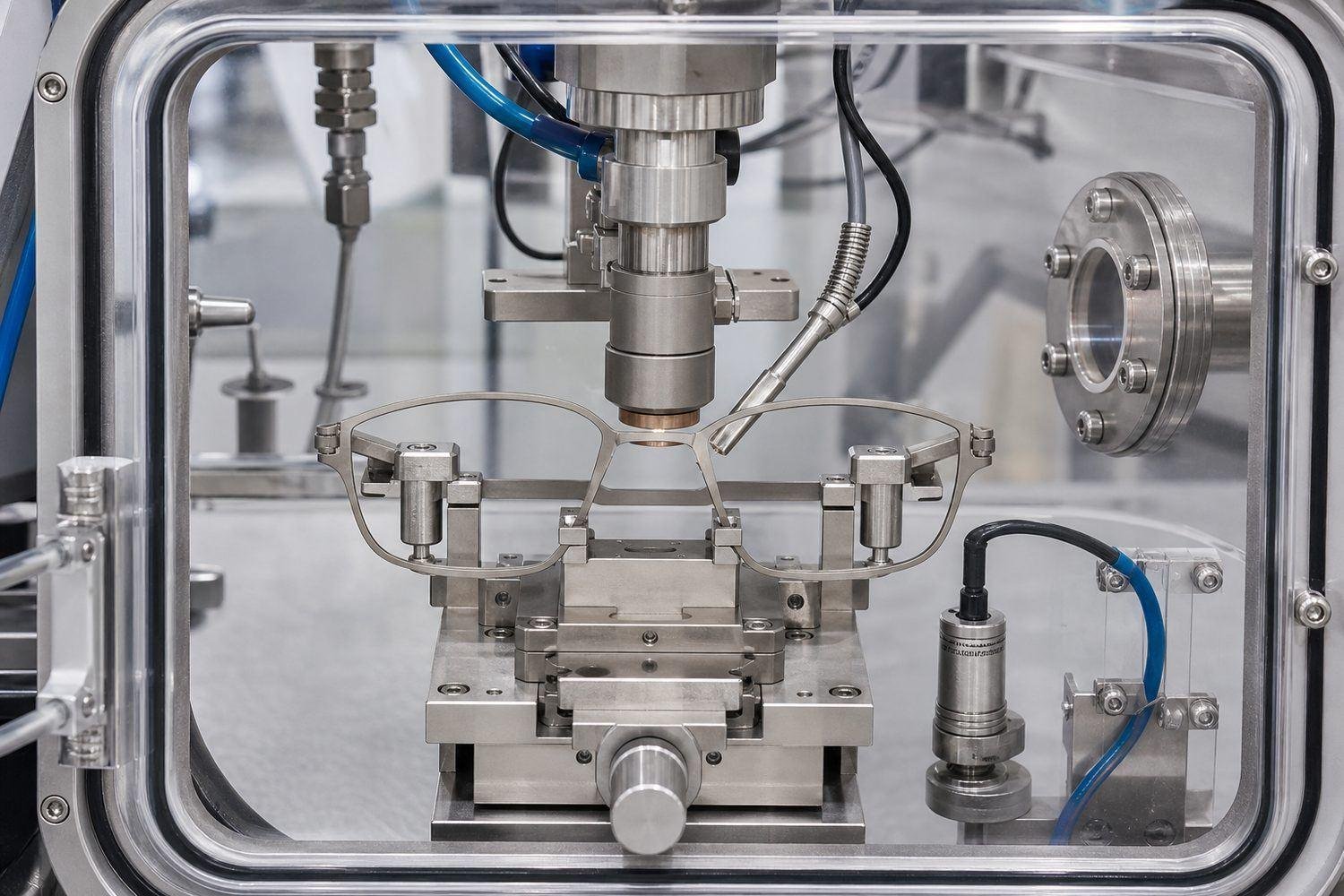
Titanium reacts readily with oxygen, nitrogen, and hydrogen when it is hot. Gas pickup can harden and embrittle the weld and surrounding HAZ. The protection must continue while those areas cool, not stop the moment the beam moves away.
TWI's guidance on welding titanium and its alloys notes titanium's high affinity for atmospheric gases above about 500°C. The weld pool, HAZ, and cooling bead therefore require inert shielding. Laser welding still needs this protection.
Primary, trailing, and backside protection
The gas nozzle protects the immediate laser interaction and molten pool. A trailing shield can cover the weld after the beam passes. A backing or purge arrangement protects the root side when heat reaches the back surface.
Small eyewear components can also be welded in a chamber filled with inert gas. A chamber can protect several sides at once and reduce sensitivity to room drafts. It still needs a controlled purge, clean fixtures, and a method for confirming the atmosphere before welding.
Argon, helium, and gas delivery
Argon is widely used because it is inert and practical. Helium or mixtures can be useful for some laser types and joint conditions. Gas species, purity, moisture, flow, nozzle position, preflow, postflow, and chamber leakage all affect protection.
More flow is not always better. Excess velocity can disturb the molten pool or pull room air into the shield. The correct value belongs in a validated welding procedure for the machine and joint.
TWI's published study on fiber-delivered laser welding of Ti-6Al-4V used coordinated shielding at the beam, behind the weld, and under the joint to produce bright, oxide-free surfaces. The setup details matter more than the gas name alone.
What weld color can and cannot tell you
A bright silver surface usually suggests good protection. Straw, blue, gray, or white colors show increasing oxide formation under many conditions. The acceptance limit must come from the applicable procedure, drawing, or standard.
Color is not a complete test. TWI research found that surface discoloration can be a poor indicator of actual contamination except when contamination is gross. A weld may look tidy while its penetration, porosity, or ductility remains unacceptable. Buyers should treat color as one inspection clue, not a certificate of weld health.
The titanium eyewear laser welding process
1. Confirm the material and joint specification
The drawing should identify the titanium grade and condition for both parts. It should also define the joint location, joint type, weld length or spot pattern, required section, cosmetic limits, and inspection method.
Joining two parts labeled only as "titanium" is risky. Commercially pure titanium and titanium alloys can respond differently to heat and filler selection. Our guides to pure titanium eyewear and titanium alloy eyewear explain why an exact grade claim matters.
2. Design the joint for the process
The joint should provide enough weld area without creating a sharp stress concentration. A butt, lap, edge, or small fillet joint needs different beam access and penetration. Parts must also leave room for shielding gas and inspection.
The drawing should set a realistic gap and alignment limit. A narrow laser beam does not bridge an uncontrolled gap well. If the part edges move from one batch to another, the weld may lose fusion on one side or burn through the other.
3. Clean and handle the parts
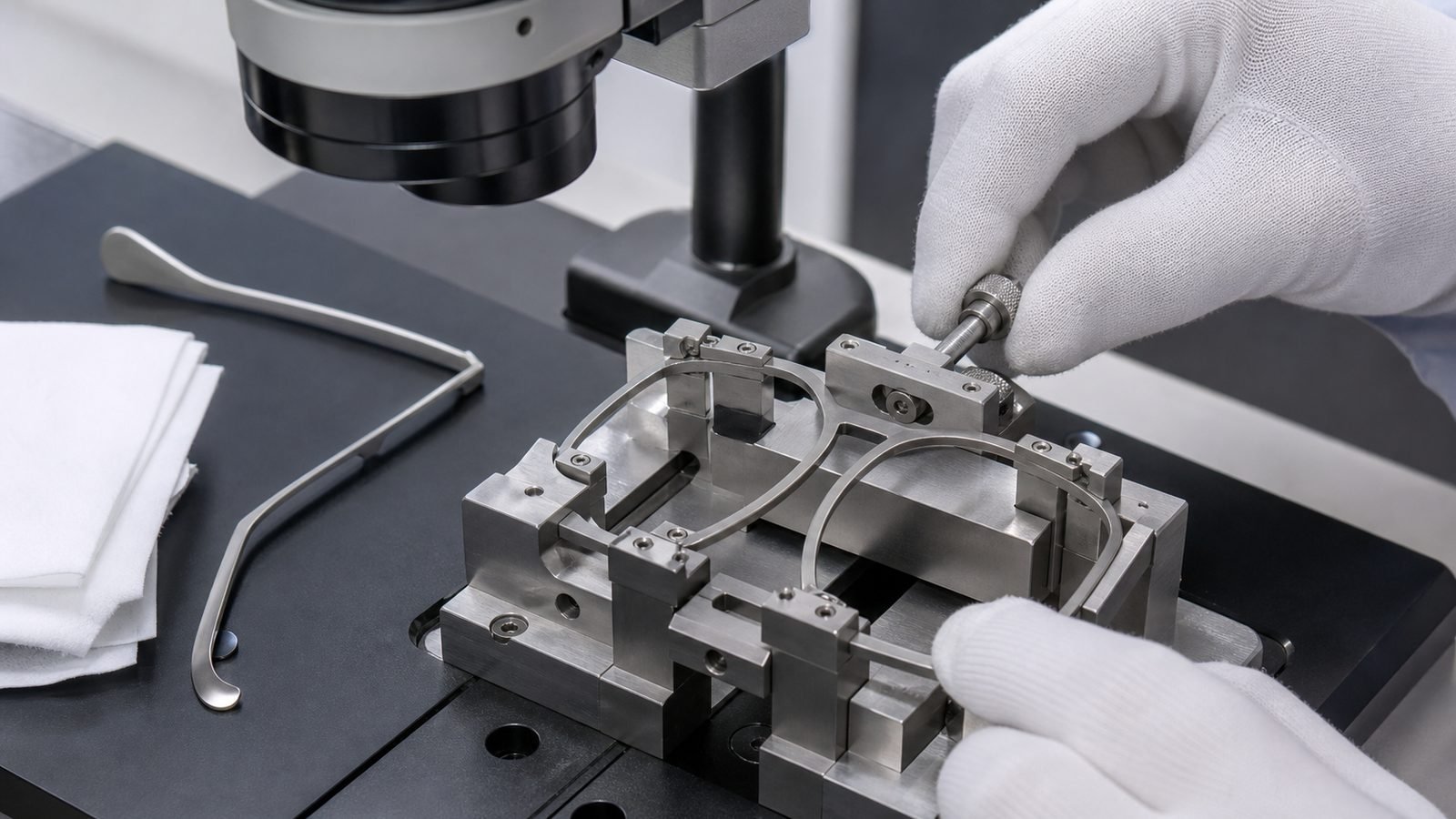
Oil, polishing compound, fingerprints, oxide, dust, and moisture can contaminate a titanium weld or create porosity. The factory should use a defined cleaning process, clean tools, lint-free handling, and protected storage between preparation and welding.
Ordinary carbon-steel brushes or contaminated benches can transfer foreign metal. Cleaning must match the material and factory safety procedures. The part should not return to an oily tray after someone has carefully prepared it.
4. Fixture and align the joint
The fixture establishes the gap, angle, and final frame geometry. It must hold thin sections without crushing them and allow the shielding gas to reach the hot zone. Reflective fixture surfaces near an exposed beam also need safety review.
For a frame front, the weld sequence should balance heat and shrinkage. Engineers may tack both sides, verify alignment, and then complete the joints in a controlled order.
5. Set focus and welding parameters
The important parameters can include beam power or pulse energy, pulse duration, pulse frequency, spot size, focus position, travel speed, overlap, wire feed if used, and shielding timing. Equipment may describe these values differently.
A wider or defocused spot changes energy density. A dirty protective window can reduce delivered power. The factory should control optics maintenance and confirm that the actual setup matches the approved recipe.
6. Weld and cool under protection
The operator or automation follows the approved tack and weld sequence. Inert gas starts before the weld and continues long enough to protect the hot metal during cooling. The required time depends on heat input, joint mass, travel, fixture, and gas arrangement.
Opening a chamber or moving a nozzle too early can contaminate an otherwise sound weld. The process is not finished when the light turns off.
7. Clean, finish, and inspect
Weld spatter, oxide, and surface irregularities should be evaluated before polishing hides evidence. Grinding a titanium weld flush can remove the section that carries the load. Any blending limit should appear on the drawing or approved work instruction.
Inspect the joint after welding and again after any finishing step that could thin it. Then test the complete frame after assembly and adjustment.
Common laser weld defects in titanium frames
Lack of fusion
Part of the joint does not melt and bond. Causes can include poor focus, low delivered energy, beam misalignment, contamination, excessive gap, or movement in the fixture. A shiny surface does not rule it out.
Incomplete or excessive penetration
Too little penetration leaves a weak effective section. Too much can create burn-through, root sag, or a hole in a thin part. The correct target depends on joint design rather than a universal percentage.
Porosity
Gas trapped during solidification creates pores. Moisture, oxide, surface contamination, shielding problems, unstable keyhole behavior, or poor fit can contribute. Small surface pores may signal larger internal issues, but visual inspection cannot find every pore.
Cracks
Cracks can form because of material choice, contamination, joint restraint, stress concentration, or an unsuitable thermal cycle. A crack is not a cosmetic defect to polish away. The factory should stop, identify the cause, and review affected parts.
Undercut and edge melting
Undercut removes material next to the weld toe. On a thin eyewear component, even a small groove may reduce the load-bearing section. Misplaced energy can also round a hinge feature or melt a lens interface.
Oxidation and embrittlement
Dark discoloration, gray deposits, or a brittle joint can indicate inadequate shielding or contamination. The corrective action is not to polish until the color disappears. The process and affected material need evaluation.
Distortion and misalignment
Local heating and solidification shrinkage can pull rims, hinges, or temples out of position. A weld can be metallurgically acceptable but still produce a frame that will not hold lenses or sit square.
Laser welding compared with other joining methods
| Process | Typical eyewear use | Main advantage | Main control issue |
|---|---|---|---|
| Laser welding | Small titanium joints, hinges, bridges, pad arms, compact seams | Concentrated heat and programmable placement | Tight fit-up, focus, shielding, and access |
| TIG welding | Larger or accessible titanium joints and repair work | Direct puddle control and established procedures | Larger torch access, heat input, and trailing protection |
| Resistance spot welding | Overlapping thin components | Fast joining without an open fusion arc | Electrode access, indentation, current, and contact condition |
| Brazing or soldering | Selected metal joints with compatible filler | Can join without fully melting both base parts | Filler compatibility, flux or atmosphere, joint clearance, and heat |
| Mechanical fastening | Screws, pins, rivets, and replaceable hinges | Disassembly or no fusion heat | Loosening, wear, hole quality, and added components |
No method wins every joint. The manufacturer should explain why the chosen process fits the material, geometry, production volume, finish, and required test result.
How to inspect a laser welded titanium frame
Visual and dimensional inspection
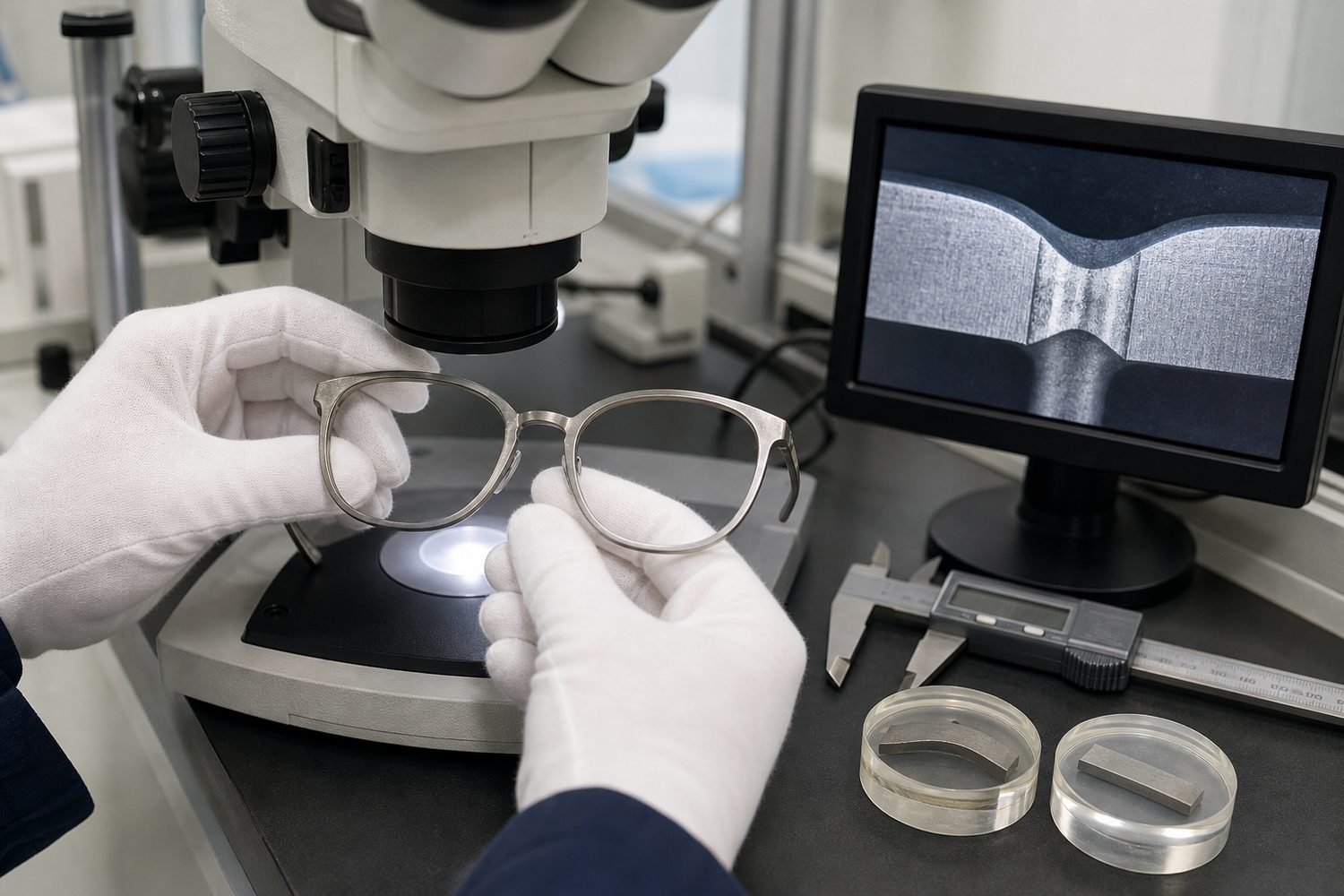
Inspectors can use magnification to check weld position, continuity, color, surface pores, cracks, undercut, excessive buildup, missing spots, and damage to nearby features. They should also measure frame width, bridge alignment, hinge position, temple angle, and other controlled dimensions.
Visual acceptance needs written limits and reference samples. "Looks clean" is not a repeatable inspection method.
Procedure qualification tests
Before production, the factory can section representative welds to inspect penetration and fusion. Depending on the joint and risk, qualification may also include tensile, pull, peel, bend, hardness, fatigue, or metallographic checks.
The sample must represent the actual material, thickness, joint, fixture, shielding, and parameters. A test coupon made from thick plate does not automatically qualify a thin hinge joint.
Production monitoring
Production controls can record the approved recipe, program revision, fixture, material lot, gas condition, operator or machine, and inspection result. Periodic destructive checks can reveal a slow shift that surface inspection misses.
ISO 13919-1:2019 gives quality levels for imperfections in laser-beam welded joints in steel, nickel, titanium, and their alloys. It applies to material thicknesses of 0.5 mm and above and states that special geometries may require an applicability review. Eyewear joints can be thinner or unusually small, so the responsible designer and manufacturer should define suitable limits instead of citing the standard blindly.
Finished-frame testing
Component weld inspection does not replace testing of the finished frame. ISO 12870:2024 covers fundamental requirements and test methods for unglazed spectacle frames intended for prescription lenses.
The final test plan should reflect the frame design, sales market, and expected loads. Our eyeglass frame quality-control overview explains how incoming records, in-process checks, and finished-frame tests connect.
What drives laser welding cost?
Joint count and access
Each weld needs positioning, shielding, and often inspection. Several accessible joints can be quicker than one joint hidden behind a rim or hinge feature.
Fixture and programming work
Custom nests, clamps, chamber fixtures, motion paths, and sample trials create setup cost. A stable product spreads this work across more units. Frequent geometry changes require new validation.
Part preparation and yield
Tight gaps and clean surfaces demand controlled upstream cutting, forming, cleaning, and handling. Poor incoming parts increase setup time, rework, and scrap at the welding station.
Shielding and chamber time
Gas consumption, chamber purge time, atmosphere checks, and leak control affect cost. A small weld may take a fraction of a second, while preparation and purge take much longer.
Inspection and qualification
Magnified inspection, dimensional checks, sectioning, mechanical tests, and retained records cost money. They also cost less than discovering weak hinge joints after coating and shipment.
Finishing and repair limits
Cosmetic blending adds labor and can remove weld material if uncontrolled. Repair may require cleaning, refixturing, a qualified repair recipe, and repeat inspection. Some defects or repeated repairs should trigger scrap instead.
These factors belong in the larger OEM eyewear manufacturing quotation and schedule.
Buyer checklist for titanium laser welding
Before sample welding
- Specify the titanium grade and condition for every joined part.
- Define joint geometry, gap, alignment, weld size, and cosmetic limits.
- State whether filler is allowed and identify it when required.
- Mark surfaces that cannot be ground, polished, or heat tinted.
- Agree on qualification samples and acceptance tests.
During process approval
- Record the laser source, focus setup, program, and critical parameters.
- Review fixture location, joint access, and weld sequence.
- Confirm cleaning, handling, and time limits after preparation.
- Verify shielding gas, nozzle or chamber arrangement, and cooling protection.
- Inspect weld cross-sections or mechanical samples that represent the real joint.
- Approve a first article and retain reference samples.
During production
- Match material lots and drawing revisions to the approved process.
- Control optics, nozzles, fixtures, and gas delivery through maintenance checks.
- Monitor weld appearance, dimensions, and alignment at defined intervals.
- Use periodic destructive checks when surface inspection cannot show fusion or porosity.
- Require written approval for parameter, filler, fixture, supplier, or repair changes.
- Connect joint inspection records to the finished frame lot.
Laser welding safety belongs in the audit
Industrial welding lasers can create serious eye, skin, reflection, fire, and airborne-contaminant hazards. A production system should use suitable enclosures, interlocks, access controls, training, beam containment, and ventilation for its classification and configuration.
OSHA's laser hazards guidance identifies direct and reflected beam hazards for high-power industrial lasers. Its technical manual also calls for ventilation where laser welding or material interaction creates hazardous fumes or vapors. Buyers do not need to operate the machine, but they should notice bypassed guards, open beams, poor extraction, and improvised work practices during a factory audit.
Frequently asked questions
Is laser welding stronger than TIG welding?
Not by default. Strength depends on material, joint design, penetration, fusion, contamination, defects, heat cycle, and finishing. Either process can produce an acceptable titanium joint when the procedure fits the application.
Does laser welding always use filler wire?
No. Closely fitted joints may be welded autogenously. Filler can help manage gaps, build section, or meet metallurgical requirements. The drawing and qualified procedure should state whether filler is used.
Does a silver titanium weld prove good quality?
No. Silver is a useful sign of surface protection, but it does not prove penetration, fusion, internal porosity, or ductility. Inspection and representative tests must support the appearance.
Can a dark titanium weld be polished and accepted?
Polishing removes visible oxide but does not reverse gas pickup or embrittlement beneath the surface. The factory should evaluate the shielding failure and the part against an approved disposition process.
Can laser welding join titanium to stainless steel?
Direct fusion joining of dissimilar metals can create brittle intermetallic phases and other compatibility problems. Do not approve it from appearance alone. The supplier needs a deliberately engineered joint, suitable intermediate material or alternate joining route, and application-specific qualification data.
Can a laser weld be repaired?
Some joints can be repaired with a controlled procedure. Repair adds another thermal cycle and may change geometry or contamination risk. Define who can approve a repair, how many cycles are allowed, and which inspections must be repeated.
Control the whole joint, not only the beam
Laser welding can make compact, repeatable joints in titanium eyewear with limited heat input. The good result comes from clean material, stable fit-up, controlled energy, complete shielding, sensible finishing, and inspection that looks below the surface. A machine name cannot substitute for those controls.
Planning a welded titanium frame? Review our titanium eyeglass frame capabilities or contact us with your drawings, materials, quantities, joint requirements, and target tests for a structured feasibility review.