
What Is Titanium Alloy Eyewear? Composition and Tradeoffs
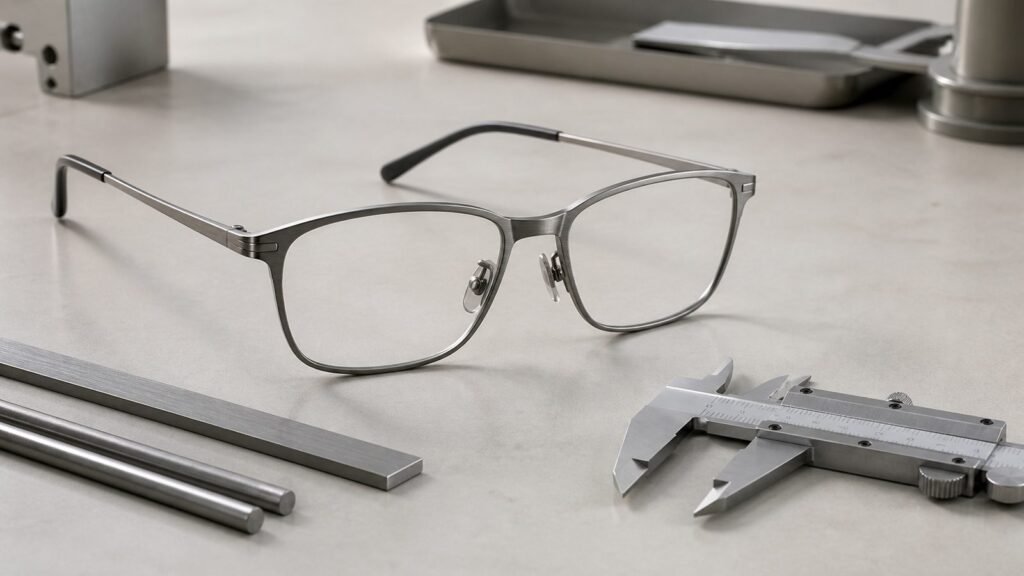
Titanium alloy eyewear uses at least one frame component made from titanium mixed with controlled amounts of other elements. Those additions can change strength, spring response, formability, corrosion behavior, and how a part reacts to heat. The phrase "titanium alloy" does not identify one material or one performance level. An alloy name, delivery condition, component map, and finished-frame test results tell you far more. This guide explains what the label can mean and how buyers can turn it into a useful specification.
What is titanium alloy eyewear?
An alloy is a metal whose composition has been adjusted with other elements to produce selected properties. In a titanium alloy, titanium remains the base metal, while elements such as aluminum, vanadium, molybdenum, niobium, tantalum, zirconium, tin, chromium, or iron may be added. No single alloy contains all of them, and each formula behaves differently.
An eyewear frame can also mix materials by component. The temples might use a springy titanium alloy, while the rims use commercially pure titanium. Hinges, screws, nose-pad arms, solder, coatings, and temple tips may use other metals or polymers.
This makes a statement such as "100% titanium alloy frame" hard to audit unless the supplier defines the denominator. Does it cover every metal component, only the visible chassis, or only the temples? A component-level bill of materials gives a clearer answer.
The broader titanium eyewear guide explains the main material families. Here, the focus is deliberate alloying and the tradeoffs it creates.
Why add other elements to titanium?
Pure titanium already offers low density, corrosion resistance, and useful formability. The Royal Society of Chemistry lists elemental titanium at about 4.5 g/cm3, well below iron by volume. Alloying lets a material engineer adjust the balance rather than accept the properties of unalloyed metal.
More strength in a smaller section
Some alloy additions and heat treatments raise yield and tensile strength. A designer may then use a thinner temple, bridge, or end piece while keeping the required load capacity.
Higher material strength does not guarantee a stronger frame. A sharp corner, thin weld, loose hinge, or deep polishing mark can still control failure. Geometry often wins the argument, as geometry tends to do.
A different balance of stiffness and springback
Strength, stiffness, and flexibility are separate properties. Elastic modulus describes how much a material deflects under a given stress. Yield strength describes when permanent deformation begins. Part thickness and shape also have a large effect on how a frame feels.
Some beta-rich titanium alloys combine high strength with a lower elastic modulus than common alpha or alpha-beta alloys. That can support flexible temples with useful recovery. Read our beta titanium guide for a closer look at that family.
Manufacturing behavior that fits the design
Alloy selection changes forming forces, springback, machining response, weldability, and heat-treatment options. A material that performs well in a finished temple may demand tighter control during forming or joining.
The best choice is therefore not the alloy with the longest property sheet. It is the alloy that can be made consistently into the approved frame.
The main titanium alloy families
Titanium changes crystal structure with temperature. Alloying elements and processing can stabilize different amounts of the alpha and beta phases at room temperature. Commercial alloys are commonly grouped as alpha and near-alpha, alpha-beta, and beta or near-beta alloys.
NASA's Aerospace Materials Characteristics describes these groups and how alloying elements affect the beta transformation temperature. The classification is useful, but it is not a shortcut to a finished-frame verdict.
Alpha and near-alpha alloys
Alpha stabilizers favor the hexagonal alpha phase. Aluminum is a common substitutional alpha stabilizer, while oxygen, nitrogen, and carbon also affect the phase and strength. Alpha-rich alloys are generally known for corrosion behavior and weldability, but many do not gain strength through conventional heat treatment in the way beta-rich alloys can.
Commercially pure grades are also alpha titanium, although they are not normally described as deliberately alloyed grades. This is one reason "alpha titanium" and "pure titanium" should not be treated as perfect synonyms.
Alpha-beta alloys
Alpha-beta alloys contain both phases. Their properties can be adjusted through composition, working, and heat treatment. Ti-6Al-4V, also called Grade 5, is a widely referenced industrial example with nominal additions of 6% aluminum and 4% vanadium.
That example should not be turned into an eyewear assumption. A product labeled only "titanium alloy" is not automatically Grade 5, and Grade 5 is not automatically the best choice for a thin formed frame. Ask which alloy was selected and why it fits the component and process.
Beta and near-beta alloys
Beta stabilizers include elements such as vanadium, molybdenum, niobium, tantalum, iron, and chromium. Retaining more beta phase can improve room-temperature formability and allow substantial strengthening through processing or heat treatment. Some beta alloys also offer the spring response sought in eyewear temples.
"Beta titanium" still describes a family, not a single formula. Two beta alloys can have different modulus, bend limits, aging response, weld behavior, and corrosion performance.
How composition changes frame performance
Strength and formability
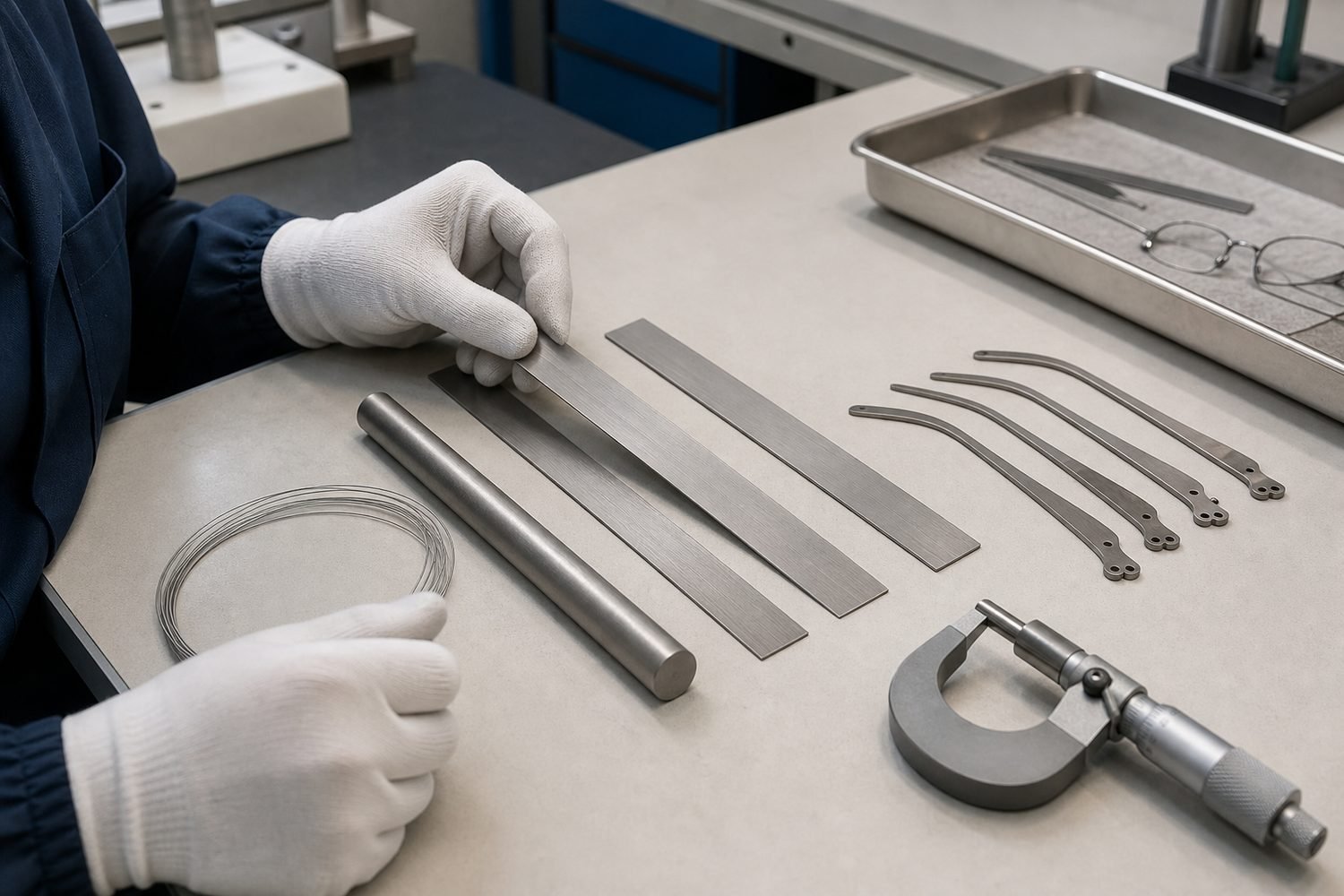
Alloying can strengthen titanium by changing its crystal phases, creating solid-solution effects, or enabling precipitation during heat treatment. Cold work can raise strength too. These same changes may reduce ductility or require more controlled forming.
A mill certificate gives the chemistry and often the mechanical properties of the supplied stock. It does not prove that a sharply bent eyewear part kept those properties after forming, welding, grinding, and finishing.
Elastic recovery and permanent set
A stronger alloy may tolerate more stress before it takes a permanent set. A lower modulus can allow more elastic deflection for the same geometry. Neither number predicts frame recovery alone because section thickness, bend radius, and local notches alter the stress.
If a product claims unusually large recovery, define a bend-and-release test on the assembled frame. Do not infer shape-memory behavior from the words "titanium alloy." Memory titanium may rely on a different mechanism and can contain nickel.
Weight
Most titanium alloys remain relatively light compared with common steels, but alloy additions change density. More importantly, frame weight depends on how much material the design uses.
Compare complete frames in the same eye size, bridge size, and temple length. A bare material density makes a poor substitute for a scale.
Corrosion behavior
Titanium owes much of its corrosion resistance to a stable surface oxide. Alloy chemistry, surface contamination, crevices, joining materials, and exposure conditions can change real product behavior.
Mixed-metal joints deserve special attention. A titanium front joined to a different hinge or screw creates a system, and the system must survive perspiration and wear. Cleaning and finishing should also avoid embedding iron or other shop contamination into the surface.
Joining and heat response
Welding locally heats the alloy and may change phase balance, grain structure, hardness, ductility, or residual stress. Cold-worked and heat-treated stock can lose some of its carefully created condition near the joint.
The process window should specify fit-up, shielding, energy input, and post-weld handling. Joint strength and fatigue tests must use production-like parts. Our eyewear manufacturing overview places joining within the full frame process.
Surface finishing and color
Polishing, blasting, anodizing, and coating interact with the alloy surface. A finish developed on commercially pure titanium may not produce the same color or consistency on another grade. Polishing can also thin edges or expose local defects if the process lacks controls.
Approve finish samples on the actual production alloy and part geometry. A flat color chip is useful, but it does not show what happens at a weld, hinge recess, or tight bend.
Does the whole frame use the same alloy?
Often it does not. Eyewear designers select materials by function, cost, joining method, and appearance. A mixed construction is not a defect when the drawing and bill of materials state it clearly.
| Frame area | Possible material choice | What to verify |
|---|---|---|
| Rims and eyewires | Pure titanium or a formable titanium alloy | Alloy, thickness, lens-retention strength, finish |
| Bridge and end pieces | Titanium alloy or pure titanium | Joint method, alignment, fatigue, corrosion |
| Temples | Beta titanium, another spring alloy, or pure titanium | Recovery, holding force, adjustment limits |
| Hinges and screws | Titanium alloy, stainless steel, or another metal | Material identity, wear, loosening, nickel release |
| Nose-pad arms | Titanium alloy, stainless steel, or wire stock | Bend life, adjustment, joint strength |
| Coatings and tips | PVD, lacquer, polymer, acetate, or silicone | Adhesion, wear, chemical resistance, skin contact |
This map also matters for "nickel-free" claims. Some standardized titanium alloys contain nickel, and non-titanium hardware can add another source. The EU restriction concerns nickel release from relevant skin-contact parts, not the elegance of the material name. ECHA lists the affected articles and release limits in its REACH nickel restriction entry.
How buyers should verify titanium alloy eyewear
1. Name the alloy and standard
Specify the grade or composition range and the material standard for each relevant component. ASTM B265:2025 covers annealed titanium and titanium alloy sheet, strip, and plate, including both unalloyed and alloyed grades. Citing the standard without a grade leaves the material question open.
Also match the standard to the stock form. Sheet, strip, wire, bar, and tube may fall under different specifications.
2. Record the delivery condition
State whether the material is annealed, cold-worked, solution-treated, aged, or supplied in another defined condition. The same chemistry can produce different mechanical behavior after processing.
Include required tensile properties, hardness, bend performance, or elastic response where they matter to the component. A generic alloy name cannot replace these acceptance limits.
3. Require lot traceability
Ask for a mill test certificate tied to a heat or lot number. Production records should connect that lot to the finished components. If material is mixed during cutting, polishing, or subcontracting, the paperwork trail breaks exactly where it is most useful.
4. Use material identification with care
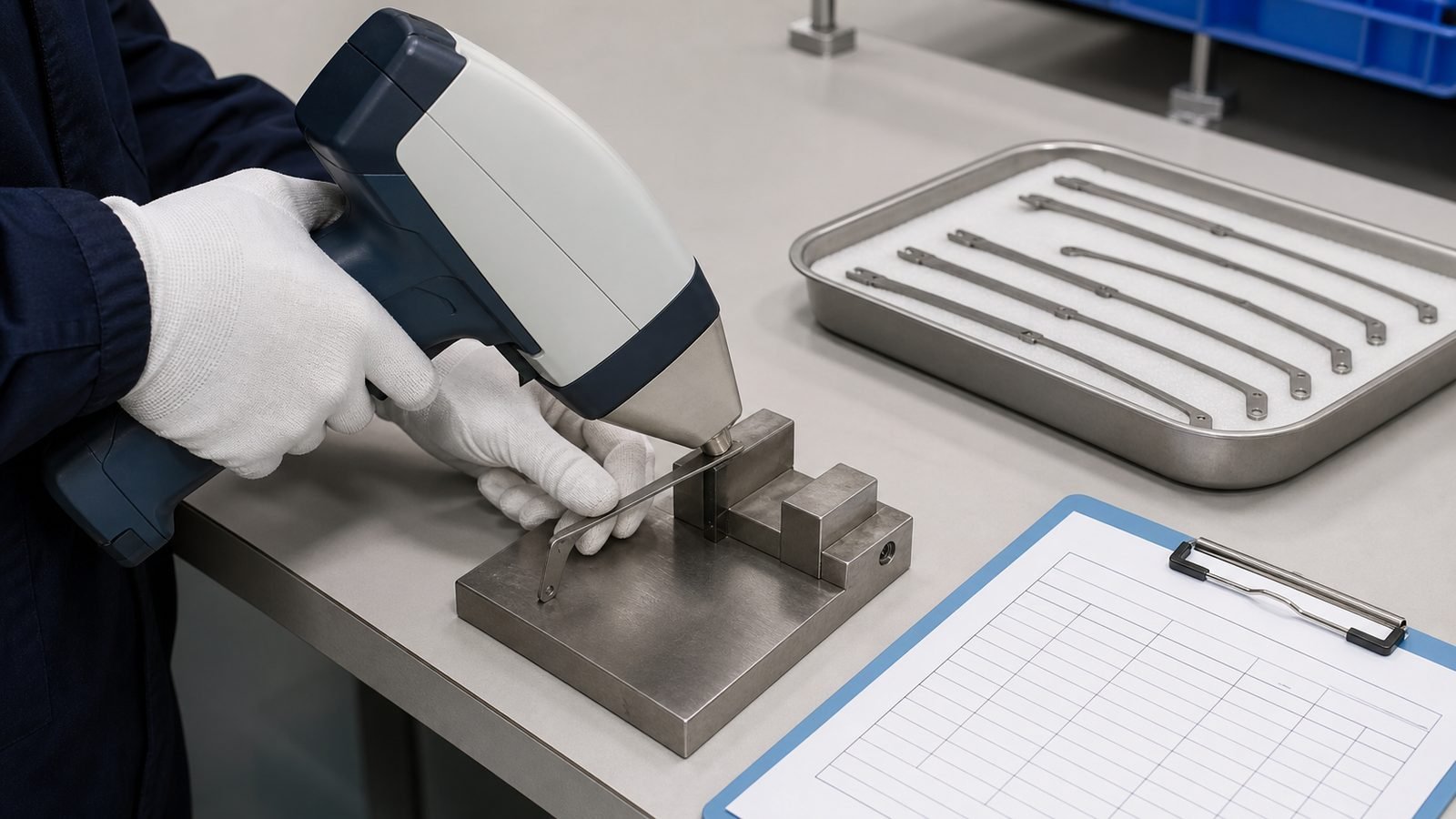
Positive material identification can help screen incoming stock and detect mix-ups. Handheld X-ray fluorescence equipment can identify many heavier alloying elements, but it may not measure light elements such as oxygen, nitrogen, or carbon well enough for grade confirmation. Some instruments also struggle with thin or curved parts.
Choose the analytical method around the alloy and the decision. Laboratory chemistry may be needed when grade boundaries depend on elements the screening tool cannot measure. Keep calibrated reference samples and a written accept-or-escalate rule.
5. Validate the manufacturing route
Approve forming, machining, joining, heat treatment, and finishing as one process chain. Record parameters that can change material condition. Revalidate after a change in alloy, supplier, stock thickness, heat-treatment route, or joint design.
Prototype approval should include production-like material, not a softer substitute chosen because it was easier to sample.
6. Test the assembled frame
A coupon cannot reveal loose hinges, weak welds, poor lens retention, or a coating that cracks during flex. ISO 12870:2024 specifies fundamental requirements and test methods for unglazed spectacle frames at the relevant point of sale.
Build the product plan around the current edition, destination-market rules, intended use, and stated claims. Our eyeglass frame quality control guide shows how incoming material checks and finished-frame tests support each other.
7. Control changes after approval
Require written approval before the factory changes the alloy grade, mill, stock condition, thickness, heat treatment, joining process, or coating stack. A sample can remain visually identical after a material substitution. Its bend life and compliance evidence may not.
Titanium alloy compared with other frame materials
| Material label | What it usually describes | Main opportunity | Main buyer check |
|---|---|---|---|
| Commercially pure titanium | Grade 1 to 4 titanium with controlled interstitials | Low density, corrosion resistance, formability | Exact grade and component coverage |
| Beta titanium | A beta-rich titanium alloy family | Flexible, strong, slim components | Exact alloy, condition, recovery, fatigue |
| Other titanium alloy | Any defined alloy outside a pure-titanium claim | Tuned strength, processing, or finish | Composition, standard, condition, process validation |
| Memory titanium | A trade label for superelastic, shape-memory, or spring material | Large recoverable movement in selected parts | Recovery mechanism, temperature range, nickel content |
| Stainless steel | An iron-based corrosion-resistant alloy family | Familiar forming, joining, and cost structure | Grade, corrosion, nickel release, frame weight |
No row is an automatic winner. The right material depends on frame geometry, feel, finish, production process, target price, and the evidence required for sale.
Frequently asked questions
Is titanium alloy lower quality than pure titanium?
No. Alloying can improve strength, spring response, or process control for a specific component. Quality depends on whether the chosen alloy, condition, design, and manufacturing route meet the product requirement.
Is titanium alloy eyewear hypoallergenic?
The label alone cannot support that claim. Check every skin-contact component, the exact alloy composition, coatings, and the applicable nickel-release requirements. Some titanium alloys and mixed hardware can contain nickel.
Is Grade 5 titanium used in eyeglass frames?
Grade 5 is a well-known titanium alloy and may suit some machined or specialized parts. Do not assume that a generic titanium-alloy frame uses Grade 5, or that Grade 5 suits every rim and temple. The supplier should identify the actual grade by component.
Can XRF prove that a frame is the specified alloy?
XRF can screen many alloying elements and catch mix-ups, but it has limits with light elements, thin sections, coatings, and small curved parts. Match the test method to the grade limits and use laboratory analysis when screening cannot answer the question.
Is beta titanium the same as titanium alloy?
Beta titanium is one titanium alloy family. "Titanium alloy" is a broader term that can include alpha, alpha-beta, near-beta, beta, and other specialized compositions.
Turn the material label into a buildable specification
Titanium alloy eyewear can deliver a useful mix of strength, low weight, flex, and corrosion resistance. The outcome depends on the exact alloy, material condition, part geometry, and production route. Name each component, keep the lot trail intact, validate the real process, and test the finished frame against its claims.
Planning a titanium frame collection? Review our titanium eyeglass frame capabilities or contact us with your drawing, target properties, finish, test market, and expected order volume.