
What Is Beta Titanium? Flexibility, Strength, and Eyewear Uses
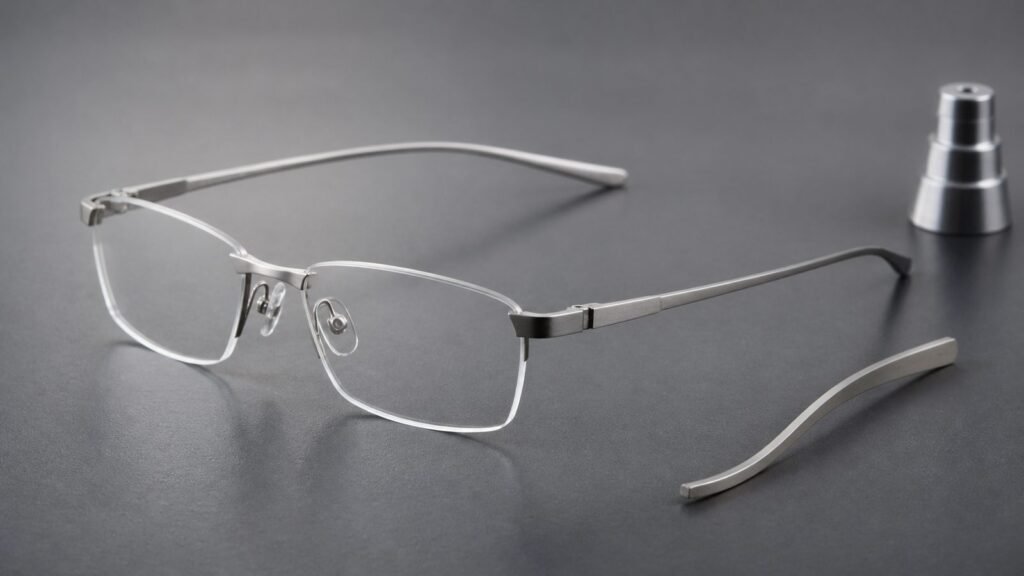
Beta titanium is a family of titanium alloys designed to retain a useful amount of the beta crystal phase at room temperature. In eyewear, manufacturers often choose it for thin parts that need strength, springback, and controlled flex. The name does not identify one universal alloy or guarantee that a frame will survive any bend. Composition, material condition, geometry, and processing all change how a part behaves. This guide explains the metallurgy in plain English and shows buyers what to verify before production.
What is beta titanium?
Titanium can form different crystal structures. The lower-temperature alpha phase has a hexagonal close-packed structure. The high-temperature beta phase has a body-centered cubic structure. Alloying elements and thermal processing can stabilize the beta phase so that some or much of it remains after the material cools.
Elements such as molybdenum, vanadium, niobium, tantalum, chromium, and iron can act as beta stabilizers in titanium alloys. The exact recipe varies. Some alloys are described as beta, metastable beta, or near-beta depending on their composition and phase balance.
That means "beta titanium" is a family name, not a complete purchasing specification. Two suppliers can use the same broad label for alloys with different chemistry, strength, elastic modulus, and processing needs. Ask for the exact alloy designation and material condition.
For the wider material map, start with what titanium eyewear is. Our guide to pure titanium eyewear explains how commercially pure Grades 1 through 4 differ from deliberately alloyed titanium.
Why does beta titanium feel flexible?
Flexible eyewear depends on more than one material number. Three ideas matter: elastic modulus, elastic limit, and component geometry.
Elastic modulus controls stiffness
Elastic modulus describes how much a material strains under a given stress while it remains elastic. A lower modulus usually makes a part feel less stiff at the same shape and size. Research on beta-type titanium alloys shows that composition affects elastic modulus and recovery behavior.
Modulus alone does not tell you how far a temple can bend safely. A low-modulus alloy with a low elastic limit may feel soft but take a permanent set too soon.
Elastic limit controls recovery
A beta titanium part springs back only while the stress stays within its recoverable range. Push it past that range and the part can remain bent, crack, or lose alignment. No alloy gets an exemption from mechanics.
Buyers should define a bend angle or displacement, the loading position, the hold time, and the allowed permanent deformation after release. "Flexible" is an adjective. A recovery test is a requirement.
Geometry can overpower the alloy label
A thin, long temple flexes more easily than a short, thick one made from the same stock. Width, thickness, taper, holes, grooves, and local bends all change stress. Even a small edge notch can become the favorite place for a crack to start.
Compare candidate designs at the same alloy, condition, and test setup. Otherwise, you may be comparing geometry while thinking you are comparing metallurgy.
What are the benefits of beta titanium in eyewear?
Controlled spring action
Beta titanium can provide useful springback in temples, bridges, and other thin sections. This can help a frame accommodate movement during wear and adjustment without feeling loose.
The word "controlled" matters. A temple that flexes freely but cannot hold the intended spread angle creates fitting problems. Designers need enough recovery for comfort and enough stiffness for stable alignment.
Strength in slim sections
Many beta titanium alloys combine useful strength with lower stiffness than commercially pure titanium. That can support thin components without making them feel like rigid wire. The result depends on alloy condition and cold work as well as nominal chemistry.
Thin sections also leave less material to absorb scratches, forming damage, or weld defects. A slim design needs tighter process control, not smaller expectations.
Low-density titanium base
Titanium has a lower density than common steels. The Royal Society of Chemistry lists titanium as a low-density, corrosion-resistant metal. Beta-stabilizing elements change the alloy density, so a beta titanium part is not always the lightest titanium option by volume.
Complete frame weight still depends on lenses, hinges, end pieces, and decorative hardware. Measure the assembled sample in the approved eye size.
Corrosion resistance
Titanium alloys form a protective surface oxide that supports corrosion resistance in many service conditions. Eyewear still needs finished-product testing because welds, coatings, screws, and mixed-metal contacts can behave differently from the base stock.
Where is beta titanium used in eyeglass frames?
Temples
Temples are a common place to use beta titanium because their length allows designers to create controlled flex. A tapered temple can tune stiffness along its length. Grooves, cutouts, and decorative twists need careful stress review.
Bridges and front structures
Beta titanium can be used where the front needs some compliance, but too much movement can affect lens retention and optical alignment. Full-rim, semi-rimless, and rimless constructions place different demands on the material.
Rimless mounts and connecting parts
Thin titanium parts can suit light rimless designs. Hole position, fastener contact, edge quality, and local section thickness become important because the load enters through small areas.
Hybrid frames
A manufacturer may combine a commercially pure titanium front with beta titanium temples. This is a valid engineering choice when the bill of materials states it clearly. The product label should not turn a mixed construction into a guessing game.
Is beta titanium the same as memory titanium?
No. Standard beta titanium eyewear should not be assumed to have a shape-memory effect. It normally relies on elastic deformation and springback. Once stress exceeds the recoverable range, permanent deformation can remain.
Shape-memory and superelastic alloys use specific compositions and phase transformations. Nickel-titanium is a well-known example, though other experimental titanium systems exist. A "memory" claim needs the alloy identity, processing condition, and a defined recovery test.
Some metastable beta titanium alloys can show unusual elastic behavior. That still does not make every beta titanium temple a memory-metal part. The next article in this series will examine memory titanium claims in detail.
How is beta titanium processed for eyewear?
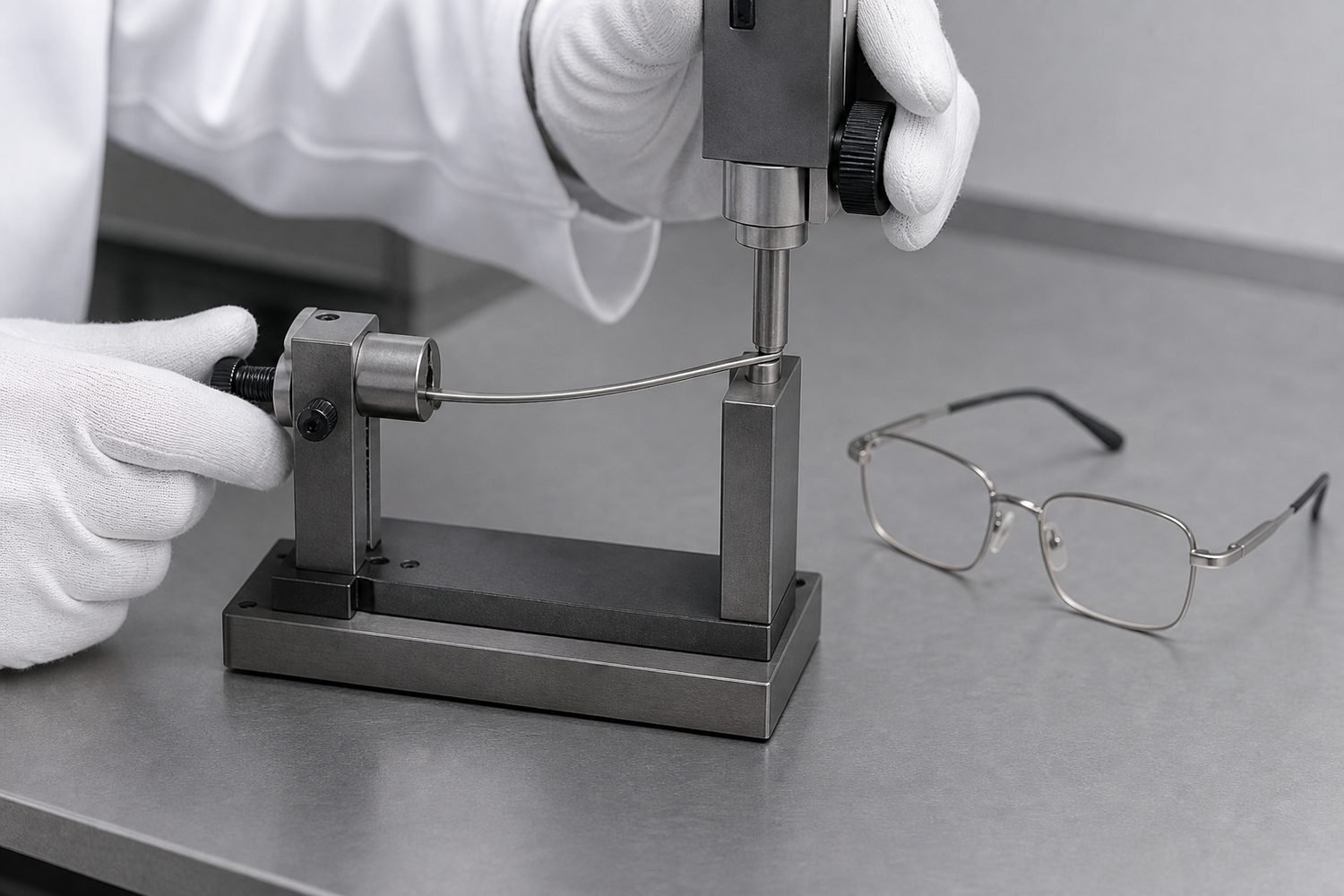
Forming and springback control
Higher springback can make beta titanium useful in service and annoying in a forming tool. Tool angles and bend allowance must account for how far the part rebounds after release. Trial parts should be measured in their relaxed state.
Cold work can raise strength and change recovery behavior. Suppliers should control forming sequence and reduction instead of treating every incoming coil or wire lot the same.
Heat treatment and material condition
Solution treatment, aging, annealing, and prior cold work can alter the phase structure and mechanical properties of beta titanium. The exact response depends on the alloy. A drawing that names only "beta titanium" leaves too much room for variation.
Specify the alloy and delivery condition, then lock the process used for the approved sample. If a heat cycle changes during welding or finishing, confirm that the part still meets its bend and strength targets.
Cutting and machining
Thin beta titanium parts may be stamped, cut, drilled, milled, or wire-formed. Sharp tools, controlled heat, and clean edges help reduce burrs and stress raisers. Slots and decorative openings need smooth transitions.
Welding and joining
Titanium requires clean joint surfaces and effective shielding during fusion welding. Hot titanium reacts with oxygen and nitrogen, which can weaken a contaminated joint. The weld area may also respond differently from cold-worked base material.
Validate the joint on a production-representative sample. Appearance alone cannot confirm strength or fatigue resistance. Our eyewear manufacturing overview explains where forming, joining, finishing, and assembly fit in the production sequence.
Surface finishing
Beta titanium can be polished, brushed, blasted, anodized, or coated. Surface preparation must remove defects without cutting too deeply into a thin section. Coating approval should include color, gloss, adhesion, coverage, and corrosion checks.
What should buyers specify and test?
1. Exact alloy and condition
Request the alloy designation, applicable material standard, delivery condition, and stock size. Record heat or lot traceability. A certificate should match the material used in the approved sample and production batch.
2. Component-level material map
State which parts use beta titanium. List the materials used for the front, bridge, temples, hinges, screws, pad arms, and trims. This also helps with corrosion and regulatory reviews.
3. Mechanical targets
Define any required tensile strength, yield strength, elongation, hardness, or elastic modulus that matters to the design. Do not copy a property from a supplier brochure without checking the stock form and material condition.
4. Bend and recovery method
Use a repeatable fixture. Specify where the load is applied, the bend angle or displacement, the number of cycles, and the recovery time. Set a maximum permanent offset and inspect the surface for cracks.
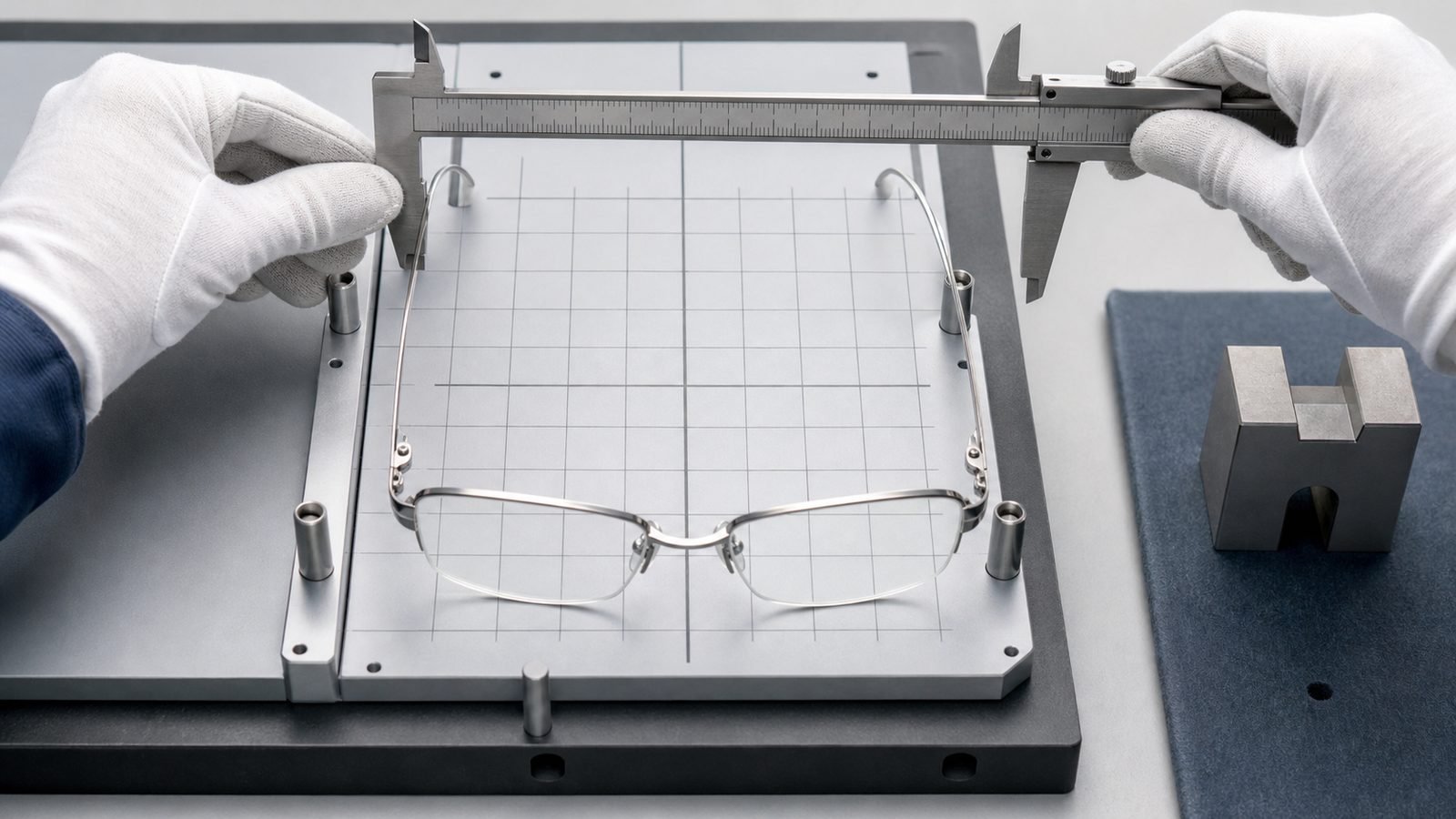
For temples, also measure frame spread, tip alignment, and symmetry after cycling. A part can recover locally while moving the whole frame out of alignment.
5. Finished-frame performance
ISO 12870 provides requirements and test methods for spectacle frames. The final test plan should match the destination market and product claims. Relevant checks can include dimensional stability, lens retention, deformation, bridge behavior, temple endurance, perspiration resistance, and screw function.
Our quality control overview shows how material checks and finished-frame testing work together.
6. Nickel and mixed-material claims
Beta titanium is not automatic proof that the finished frame is nickel-free. Hinges, screws, plating layers, and decorative parts may use other metals. If nickel release matters, verify the complete product against the applicable market requirements, including the EU REACH nickel restriction.
Beta titanium compared with other frame materials
| Material family | Typical behavior | Main limitation to verify |
|---|---|---|
| Commercially pure titanium | Corrosion-resistant titanium with grade-based strength and formability | Lower spring range in many comparable thin designs |
| Beta titanium | Alloy family that can combine strength, lower stiffness, and useful springback | Properties vary by alloy, condition, and processing |
| Memory alloy | Can recover through a designed superelastic or shape-memory mechanism | Claim needs exact alloy and recovery conditions |
| Stainless steel | Strong, familiar, and available in many component forms | Different density, corrosion, and nickel considerations |
No row is a universal winner. Choose the material after defining fit, thickness, adjustment, durability, finish, and compliance needs.
Frequently asked questions
Does beta titanium contain nickel?
The name does not define one composition. Many beta titanium alloys use other beta stabilizers, but you should verify the exact alloy and every non-titanium component. A finished-frame nickel-free claim requires product-level evidence.
Is beta titanium stronger than pure titanium?
Many beta titanium alloys can reach higher strength than commercially pure grades, especially in specific cold-worked or heat-treated conditions. Compare the actual alloy, condition, stock form, and test certificate.
Will beta titanium return to shape after any bend?
No. It springs back only within its recoverable range. Excessive bending can leave a permanent set or create damage.
Is beta titanium lighter than pure titanium?
Not always by volume. Alloying elements can raise density. A beta titanium design may still produce a light frame because its strength and flexibility allow slim sections.
Can an XRF analyzer confirm beta titanium?
XRF can identify titanium and many metallic alloying elements. Whether it can confirm a specific grade depends on the alloy limits and the elements that distinguish it. Use a material certificate and a suitable laboratory method when the risk calls for stronger proof.
Specify the behavior, not just the label
Beta titanium earns its place in eyewear when the alloy and geometry work together. Name the alloy, lock the material condition, test springback with a repeatable fixture, and check the finished frame. That gives buyers a useful flex claim instead of a bendy marketing adjective.
Developing a beta titanium optical or sunglass frame? Review our titanium eyeglass frame capabilities. You can also contact us with your drawing, target weight, fit requirements, and recovery test.