
What Is Pure Titanium Eyewear? Grades, Benefits, and Buyer Checks
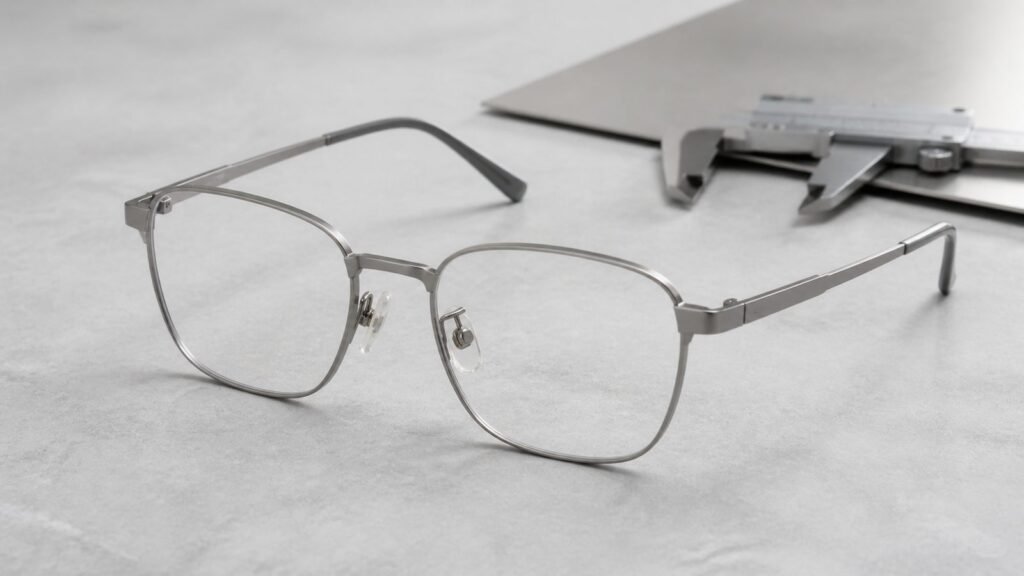
Pure titanium eyewear uses commercially pure titanium for specified frame components. That sounds simple until a material label meets a bill of materials. A frame may have a pure titanium front but use different metals in its hinges, screws, or decorative parts. Commercially pure titanium also comes in several grades, each with a different balance of formability and strength. This guide explains what the label means, how the grades differ, and what a buyer should verify before approving production.
What does "pure titanium eyewear" mean?
In manufacturing, "pure titanium" usually means commercially pure titanium, often shortened to CP titanium. It is not laboratory-pure elemental titanium. CP titanium contains controlled amounts of elements such as oxygen, iron, carbon, nitrogen, and hydrogen. Those small differences affect strength, ductility, and forming behavior.
ASTM B265 covers titanium and titanium-alloy strip, sheet, and plate, including the commercially pure grades commonly identified as Grades 1 through 4. A material certificate should name the specification, grade, heat or lot, dimensions, and test results that apply to the supplied stock.
Eyewear labels need another layer of detail. "Pure titanium frame" might describe the front, the temples, or both. It does not automatically describe every screw, hinge barrel, pad arm, nose-pad insert, or coating layer. A buyer should define the material at component level instead of relying on one phrase printed on a temple.
For a broader introduction to titanium frame categories, read our guide to what titanium eyewear is.
How do commercially pure titanium grades differ?
Grades 1, 2, 3, and 4 are all unalloyed titanium grades in the commercial sense. Their controlled chemistry and mechanical properties are not identical. As the grade number rises, specified strength generally rises too, while easy forming and ductility generally decrease.
| CP titanium grade | General material character | Possible eyewear consideration |
|---|---|---|
| Grade 1 | Softest and most formable of the four common CP grades | Useful when deep forming or aggressive shaping matters more than maximum strength |
| Grade 2 | Moderate strength with good formability | A practical reference point for many formed frame components |
| Grade 3 | Higher strength and lower ductility than Grade 2 | May suit parts that need more strength but can tolerate tighter forming limits |
| Grade 4 | Highest strength of the common CP grades | Can support stronger thin parts, but forming and process control become less forgiving |
This table is a selection guide, not a substitute for a drawing. Stock condition, thickness, work hardening, heat history, and the geometry of the component can matter as much as the grade name.
Grade 1
Grade 1 offers high ductility and low strength compared with the other CP grades. It can handle demanding forming operations, but a very soft material may not deliver the stiffness or shape retention a thin eyewear part needs. The frame design still has to do some work. Metallurgy cannot rescue a temple that is too thin in the wrong place.
Grade 2
Grade 2 sits between easy forming and useful strength. That balance makes it worth evaluating for many eyewear parts. Still, "Grade 2" alone does not prove that a finished frame will be light or durable. Section size, hinge design, joining quality, and final adjustment still control the result.
Grades 3 and 4
Grades 3 and 4 provide progressively higher specified strength within the CP family. They can be useful when a part needs more strength without moving to a deliberately alloyed titanium grade. The tradeoff is tighter process control during bending and forming, with more attention to springback and cracking risk.
Do not select a higher grade simply because the number looks better on a specification sheet. Choose the grade that fits the component, forming route, and performance target.
What are the benefits of pure titanium eyewear?
Low density
The Royal Society of Chemistry lists titanium as a low-density metal with good strength and corrosion resistance. In eyewear, low density can reduce frame weight when the designer also keeps sections slim and avoids unnecessarily heavy hardware.
Weight is a system result. A titanium front paired with thick lenses, oversized end pieces, or heavy spring hinges may still feel substantial. Ask for the complete frame weight in the approved lens size, not just the density of the base metal.
Corrosion resistance
Titanium forms a stable surface oxide that helps it resist many everyday corrosive conditions. That is useful for eyewear exposed to perspiration, humidity, cosmetics, and regular handling.
The finished frame still includes joints, screws, coatings, and contact points. Corrosion or discoloration can begin at those mixed-material areas even when the main rim remains sound. Finished-frame testing gives a more useful answer than a raw-material brochure.
Skin-contact potential
CP titanium can be a good base material for products intended for prolonged skin contact. Yet a pure titanium claim is not the same as a nickel-free claim. A frame may contain nickel in hinges, screws, plating underlayers, or decorative pieces.
For products sold in markets with nickel-release limits, verify the complete article against the applicable rule. The EU REACH nickel restriction applies to articles intended for direct and prolonged contact with skin, including relevant eyewear components.
A clean engineering baseline
CP titanium gives a product team a clear starting point. The grade can be specified, the incoming material can be tied to a certificate, and the frame can be tested against defined requirements. That makes the claim easier to audit than a vague label such as "premium titanium metal."
Is every part of a pure titanium frame made from CP titanium?
Not necessarily. Eyeglass frames mix tiny parts with very different jobs. A rim must hold a lens. A temple must survive repeated opening. A hinge pin needs wear resistance. A screw needs reliable threads. One material is rarely ideal for every task.
A frame sold as pure titanium may include:
- CP titanium rims, bridge, end pieces, or temples
- a different titanium alloy in flexible temple sections
- stainless steel or another alloy in screws and hinge pins
- non-titanium pad arms, nose-pad inserts, or decorative trims
- coating, plating, lacquer, or adhesive over the base metal
None of these choices automatically makes the frame poor quality. The problem starts when the claim is vague. Your product specification should state which parts are CP titanium, which grade applies, and which exceptions are allowed.
How does pure titanium affect frame manufacturing?
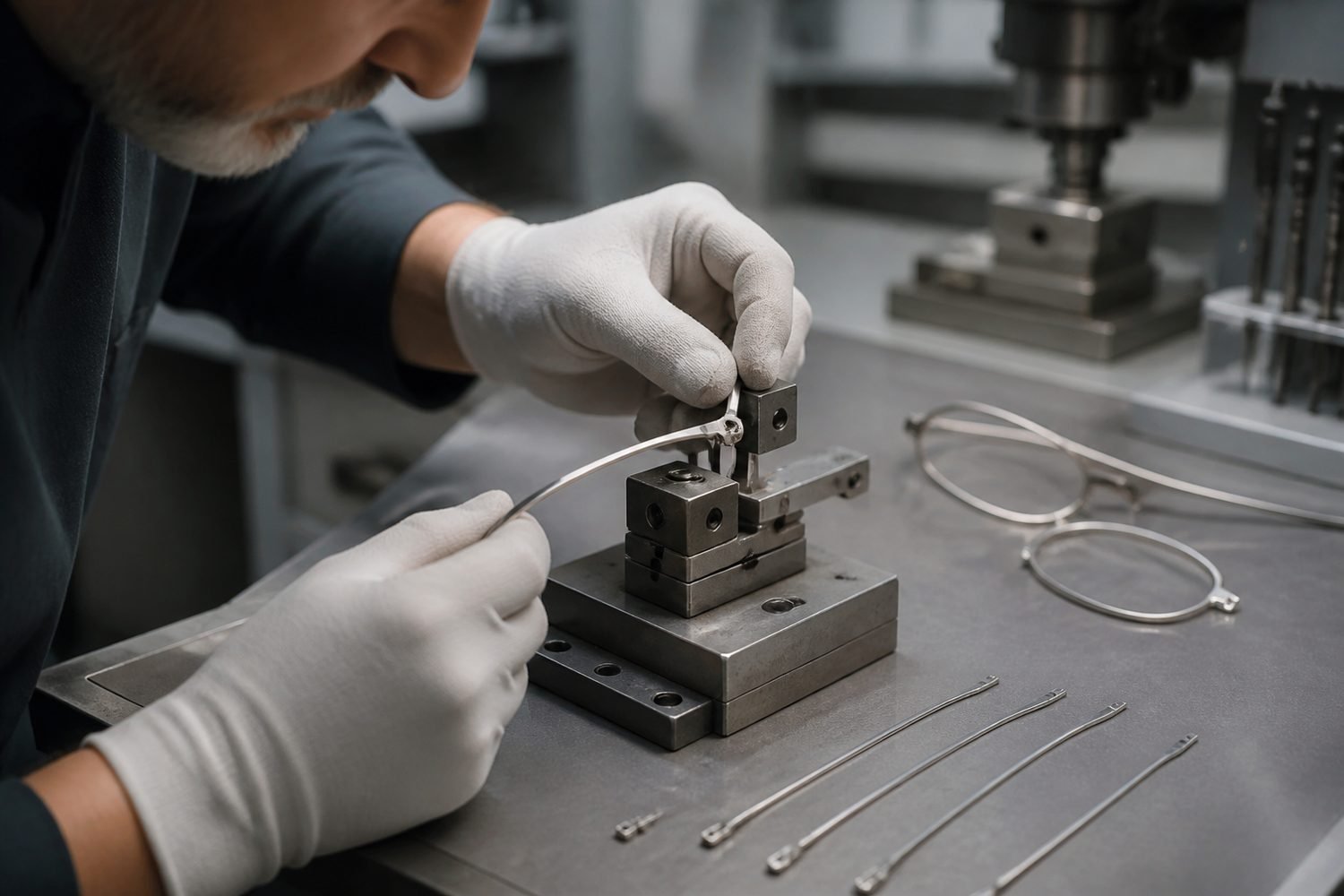
Forming and springback
Titanium does not behave like common nickel silver or stainless steel during forming. Tooling, bend radius, stock condition, and forming sequence must match the selected grade and section. Springback can shift a bridge curve or temple angle after the tool releases the part.
Prototype measurements should include the relaxed part. Measuring a part only while it sits in a fixture can hide springback. Production checks should watch dimensions that affect lens fit, face-form angle, temple spread, and symmetry.
Cutting and machining
Pure titanium parts may be stamped, wire-formed, cut, drilled, milled, or turned. Cutting parameters and tool condition matter because titanium can generate concentrated heat at the cutting edge. Poor control can leave burrs, rough holes, or damaged threads on very small components.
Our eyewear manufacturing overview explains how component production fits into the wider frame process.
Joining
Clean surfaces and controlled shielding matter when titanium parts are welded. At elevated temperature, titanium reacts readily with oxygen and nitrogen. A contaminated or poorly protected joint may become brittle even when it looks acceptable after polishing.
The approved process should define joint preparation, fit-up, welding parameters, shielding, and inspection. If the design joins titanium to a dissimilar metal, document that interface separately.
Finishing and color
Titanium can be polished, brushed, blasted, coated, or anodized. Each route creates a different appearance and service behavior. A color sample is useful, but it should come with measurable limits for gloss, color difference, coverage, and adhesion.
Finishing can also hide surface defects. Inspect the base part before coating, then inspect the finished frame again under controlled lighting.
What should buyers verify before production?
1. Define the material by component
Create a bill of materials that names the material for the front, bridge, rims, end pieces, temples, hinges, screws, pad arms, and decorative parts. State the CP titanium grade where it matters. Mark any permitted substitutions in writing.
2. Request traceable material records
Ask for a material certificate tied to the heat or lot used for production. Check the specification, grade, chemistry, mechanical properties, stock size, and supplier identity. A generic certificate with no link to the incoming batch is paperwork-shaped decoration.
3. Match the verification method to the claim
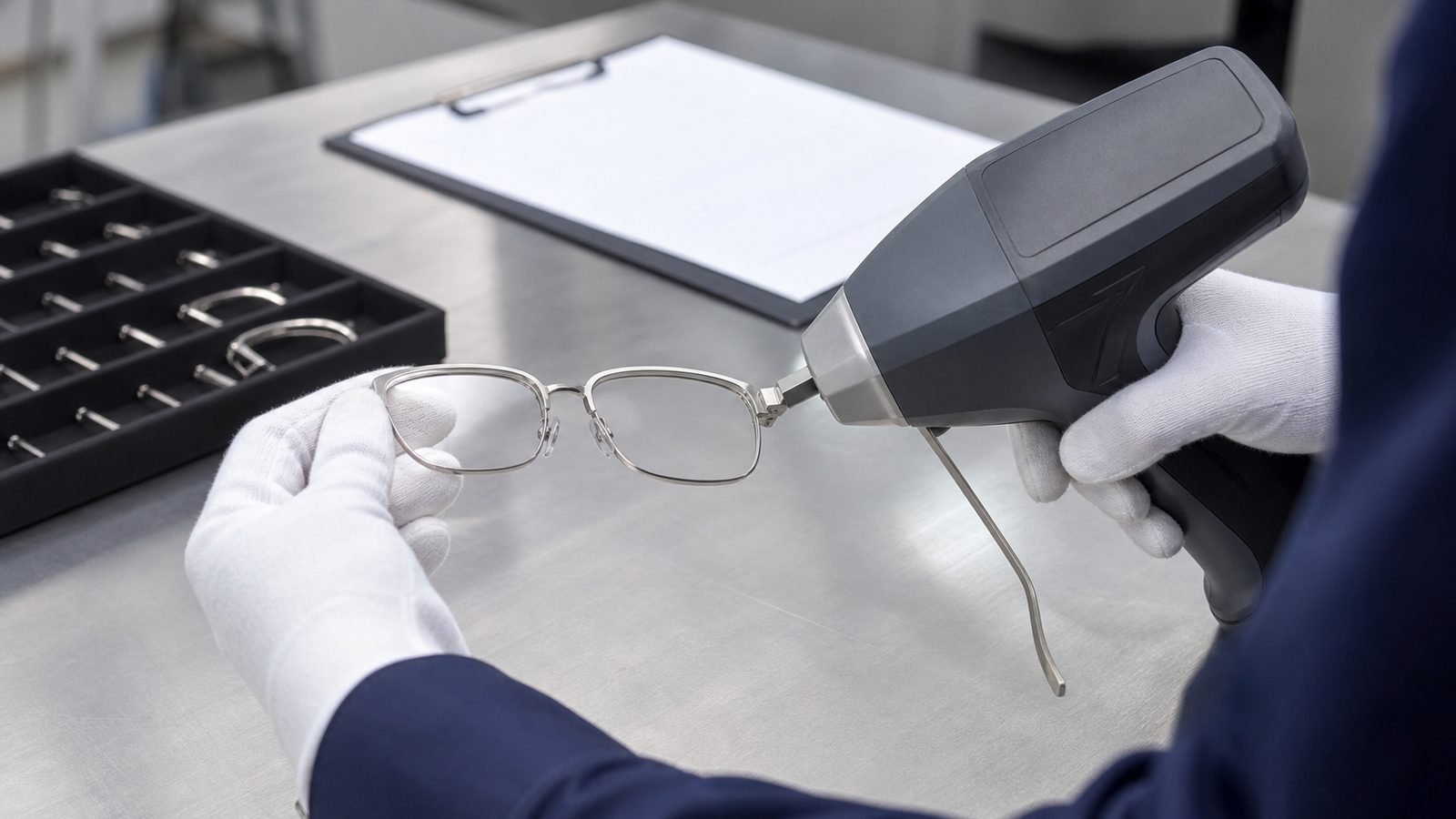
Positive material identification can help confirm that a part is titanium and detect many metallic alloying elements. It may not be enough to distinguish every CP grade because grade limits also depend on light interstitial elements. Use the material certificate and, when risk justifies it, a suitable laboratory method for grade confirmation.
The test method should answer a defined question. "Scan it with a gun" is an activity, not a quality plan.
4. Approve a production-representative sample
The sample should use the intended grade, section thickness, tooling, joining process, and finish. Record critical dimensions and frame weight. Test adjustment behavior and check whether repeated handling creates cracks, looseness, or permanent distortion.
5. Test the finished frame
ISO 12870 specifies requirements and test methods for spectacle frames. Your exact plan will depend on the destination market and product claim. Common checks cover dimensions, lens retention, deformation, bridge behavior, temple endurance, screw function, perspiration resistance, and ignition resistance.
Material verification and performance testing solve different problems. One confirms what the frame is made from. The other checks whether the completed frame works.
6. Control changes during mass production
Lock the approved material source, grade, finish stack, and critical processes. Require written approval before a supplier changes stock, subcontractor, coating system, or joining method. Incoming checks and lot records should make a later investigation possible without archaeology.
Our quality control guide shows where these checks fit in production.
Pure titanium vs. beta titanium vs. stainless steel
| Material family | Typical design reason | Main buyer question |
|---|---|---|
| Commercially pure titanium | Low density, corrosion resistance, clear unalloyed grade specification | Which components and which CP grade? |
| Beta titanium | Higher elastic flexibility and spring behavior in suitable designs | What alloy, condition, and recovery target? |
| Stainless steel | Familiar forming, joining, and hardware options at a different cost and weight profile | Which stainless grade and surface system? |
These are material families, not guaranteed outcomes. A well-engineered stainless frame can outperform a poorly designed titanium frame. Compare complete products against the same dimensional, durability, finish, and compliance requirements.
Frequently asked questions
Is pure titanium eyewear 100% titanium?
Usually not in the literal sense. The specified main components may use commercially pure titanium, while screws, hinges, coatings, and small fittings use other materials. Ask for a component-level declaration.
Is Grade 4 always better than Grade 2 for eyewear?
No. Grade 4 offers higher strength within the CP group, while Grade 2 is easier to form. The right choice depends on part geometry, thickness, forming route, and required performance.
Can XRF prove that a frame is Grade 2 titanium?
XRF can help identify titanium and many alloying elements, but CP grade differences also involve light interstitial elements that may require other methods. Use XRF as part of a verification plan, not as automatic proof of a specific CP grade.
Is pure titanium eyewear nickel-free?
Not automatically. Non-titanium hardware and coating layers may contain nickel. Test or document the complete frame according to the rules and claims that apply to the destination market.
Does pure titanium eyewear need a coating?
No. Titanium can be polished, brushed, blasted, or anodized without a conventional plated color layer. Coatings can add color or a chosen surface effect, but the specification should define their adhesion and appearance requirements.
Turn "pure titanium" into a testable specification
The strongest material claim is one that a factory and buyer can both verify. Name the CP grade, map it to specific components, keep batch records, and test the finished frame. That turns "pure titanium" from a temple stamp into an engineering requirement.
Planning a new titanium optical or sunglass collection? Review our titanium eyeglass frame capabilities. You can also contact us with your drawings, target market, and material questions.